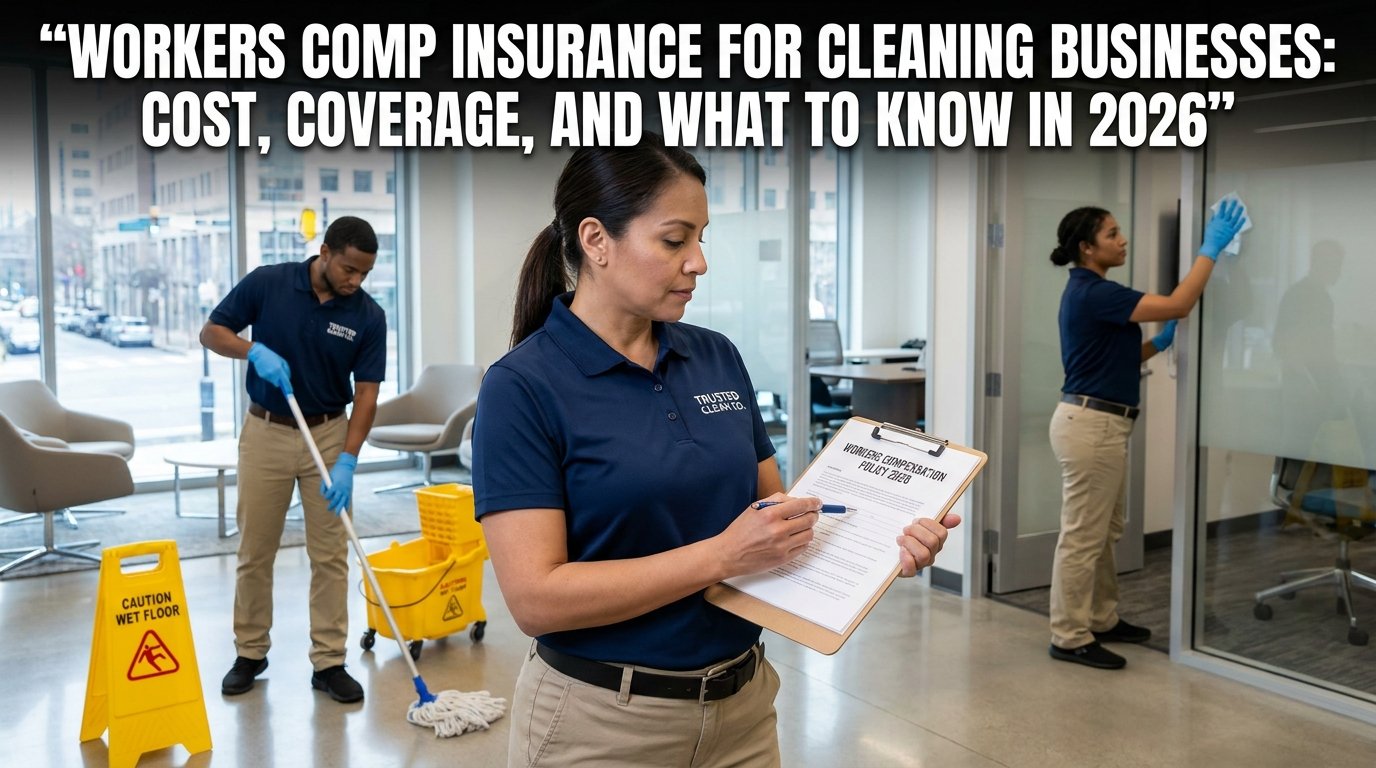
Workers Comp Insurance for Cleaning Businesses– If you run a cleaning company, one slip on a wet floor or one back strain from lifting supplies can turn into a costly problem fast. That’s why workers comp insurance for cleaning businesses matters so much. It helps cover employee injuries, protects your business from major out-of-pocket costs, and may be required by state law.
Cleaning work looks simple from the outside, but the injury risk is real. Employees move fast, work around chemicals, climb stairs, lift equipment, and clean in homes, offices, and commercial buildings. This guide breaks down how coverage works, what it usually pays for, what affects pricing, and the mistakes owners should avoid.
What Is Workers Comp Insurance?
Workers’ compensation insurance helps pay for costs when an employee gets hurt or becomes ill because of work. In most cases, that includes:
- Medical bills
- Part of lost wages
- Physical therapy or rehab
- Disability benefits
- Death benefits for a worker’s family in severe cases
For employers, it also adds an important layer of legal protection. In many situations, an injured worker who accepts workers’ comp benefits cannot sue the employer for the same injury.
Why Cleaning Businesses Need It
Cleaning companies face more injury exposure than many owners first expect. Employees often deal with:
- Slippery floors
- Repetitive motion injuries
- Back and shoulder strain
- Falls from steps or ladders
- Chemical exposure
- Cuts from tools or broken glass
That makes workers comp insurance for cleaning businesses more than a box to check. It is a core part of running a stable operation.
Say you own a small maid service with four employees. One cleaner slips while mopping a tile lobby and fractures a wrist. Without coverage, your business could end up paying the emergency bill, follow-up care, and lost wages directly. With a workers’ comp policy, those costs are usually handled through the insurance carrier, subject to the policy and state rules.
What Workers Comp Insurance for Cleaning Businesses Covers
Coverage depends on your state and policy, but it usually includes the following:
Medical Treatment
If an employee is injured on the job, workers’ comp typically pays for reasonable and necessary medical care. That may include:
- ER visits
- Doctor appointments
- Surgery
- Prescription drugs
- X-rays and scans
- Physical therapy
Partial Wage Replacement
If the worker cannot return to the job right away, the policy usually pays a portion of their wages for a limited period under state rules.
Ongoing Disability Benefits
Some injuries lead to temporary or permanent disability. In that case, benefits may continue based on how serious the injury is and whether the worker can return to work.
Employer Liability Protection
Many policies include employer’s liability coverage. This can help if a claim turns into a lawsuit outside the normal workers’ comp process.
Death Benefits
If a job-related injury leads to death, the policy may provide funeral benefits and support for dependents, based on state law.
What It Usually Does Not Cover
Even strong coverage has limits. Workers’ comp often does not cover:
- Independent contractors, if they are truly independent under state law
- Injuries that happen off the job
- Intentional misconduct
- Claims involving intoxication, depending on state rules
- Damage to business property
- General liability claims from clients or third parties
This is where many owners get confused. Workers’ comp covers employee job injuries. It does not replace general liability, commercial auto, or bond coverage.
How Much It Costs
The cost of workers comp insurance for cleaning businesses varies widely. Insurers usually look at payroll, job duties, claims history, and the state where you operate.
In general, cleaning businesses often pay more than low-risk office businesses because physical work creates more injury exposure. A small residential cleaning company with a clean claims history may pay much less than a larger janitorial contractor handling commercial sites, post-construction cleanup, or floor treatment work.
Your premium is commonly based on this simple formula:
Premium=(Payroll100)×Class Rate×Experience Modifier
Example
If your cleaning company has $120,000 in payroll, a classification rate of $4.00 per $100 of payroll, and an experience modifier of 1.10, the estimated premium would be:
(120,000/100)×4.00×1.10=5,280
That is only an example, not a quote. Actual rates depend on your insurer and state-specific rules.
What Affects Your Premium
Several factors shape what you pay for workers comp insurance for cleaning businesses.
1. Payroll Size
More payroll usually means a higher premium because there is more worker exposure.
2. Type of Cleaning Work
Residential maid service, janitorial contracts, carpet cleaning, window cleaning, and post-construction cleanup can have different risk levels.
3. Claims History
If your company has frequent injury claims, insurers may charge more.
4. Experience Modifier
Larger businesses may receive an experience modification rate, often called an e-mod. A better claims record can reduce cost, while a poor one can raise it.
5. State Requirements
Workers’ comp rules are mostly handled at the state level. That means required benefits, employer thresholds, and pricing rules differ depending on where the business operates.
6. Employee Classification
Correct class codes matter. Misclassifying workers can lead to underpayment, audit problems, penalties, or premium increases later.
State Law and Compliance Basics
Most states require businesses with employees to carry workers’ compensation coverage, but the exact rule varies. Some states require it as soon as you hire one employee. Others have different thresholds or special rules for family members, corporate officers, or part-time staff.
Because of that, you should always verify your state’s current requirements with the state workers’ compensation board or labor department. For a YMYL topic like this, that step matters. Rules can change, and official state guidance controls.
If your business operates in more than one state, things get more complex. You may need coverage that addresses each state where employees actually work.
Common Mistake Taxpayers and Business Owners Make
A common mistake business owners make is assuming that calling a worker an “independent contractor” means workers’ comp does not apply. That can backfire badly.
If the state or insurer decides that worker functions like an employee, your business may owe back premium, penalties, and uncovered claim costs. For cleaning companies, this issue comes up often because teams may work part-time, use flexible schedules, or move between job sites. Classification should be based on the actual working relationship, not just the label in a contract.
How to Lower Risk and Premium
You cannot remove risk completely, but you can manage it well.
Build a Basic Safety Program
Create simple written rules for:
- Wet floor procedures
- Safe lifting
- Ladder use
- Chemical handling
- Protective gloves and footwear
- Injury reporting steps
Train New Hires Early
Do not assume experienced cleaners already know your methods. A short onboarding process can prevent a lot of injuries.
Keep Good Records
Track incidents, near misses, payroll, and job classifications carefully. Good records help during audits and policy renewal.
Return-to-Work Planning
When appropriate, a light-duty return-to-work plan may reduce claim severity and help employees transition back safely.
Shop Coverage Carefully
Do not compare only price. Look at:
- Carrier reputation
- Claims handling
- Industry experience
- Audit process
- Payment plan options
For a cleaning company, the cheapest policy is not always the best value.
Do Sole Proprietors Need It?
If you run a solo cleaning business with no employees, you may not be legally required to buy workers’ comp in some states. Still, rules vary, and some contracts may require proof of coverage even for owner-only operators.
This issue comes up often with subcontracting. A property manager or larger janitorial partner may require you to carry workers’ comp before giving you work. So even when it is not strictly required by law, it may still be a smart business move.
How It Fits With Other Insurance
Workers comp insurance for cleaning businesses is only one part of a complete protection plan. Many cleaning companies also need:
- General liability insurance for third-party bodily injury or property damage
- Commercial auto insurance for business vehicles
- Janitorial bond if clients want protection against employee theft
- Commercial property insurance for equipment and supplies
- Umbrella insurance for added liability limits
Each policy covers a different risk. One policy does not replace the others.
Key Takeaways
- Workers comp insurance for cleaning businesses helps cover job-related employee injuries and lost wages.
- Cleaning companies face real injury risks, including slips, strains, falls, and chemical exposure.
- Cost depends on payroll, claims history, job type, location, and worker classification.
- State law determines whether coverage is required and how benefits work.
- Misclassifying employees as contractors is one of the most common and costly mistakes.
- Safety training and good recordkeeping can help reduce claims and control premiums.
Conclusion
For most employers, workers comp insurance for cleaning businesses is not optional in practice, even when the law gives limited exceptions. It protects your employees, supports your business after an injury, and helps you stay compliant. If you run a maid service, janitorial company, or commercial cleaning operation, review your worker classifications, payroll records, and state requirements carefully before you buy or renew coverage.
Workers Comp Insurance for Cleaning Businesses FAQ
Do cleaning businesses need workers comp insurance?
In many states, yes. If you have employees, workers’ comp is often required by law, though the exact threshold depends on your state.
How much is workers comp insurance for a cleaning business?
It depends on payroll, job classification, claims history, and state rules. Higher-risk cleaning operations usually pay more than low-risk office-based businesses.
Does workers’ comp cover part-time cleaning employees?
Often yes, if they are employees under state law. Part-time status alone does not automatically remove the requirement.
Are independent contractors covered under workers’ comp?
Usually not, but this depends on whether they are truly independent under state rules. Misclassification is a major risk for cleaning companies.
What does workers comp insurance for cleaning businesses cover?
It usually covers medical care, partial lost wages, rehab costs, disability benefits, and certain employer liability claims related to workplace injuries.
Disclaimer
This article is for general educational purposes only and does not provide legal, tax, or insurance advice. Workers’ compensation rules and coverage terms vary by state, insurer, and business structure. Review current state guidance and speak with a licensed insurance professional or attorney before making decisions.