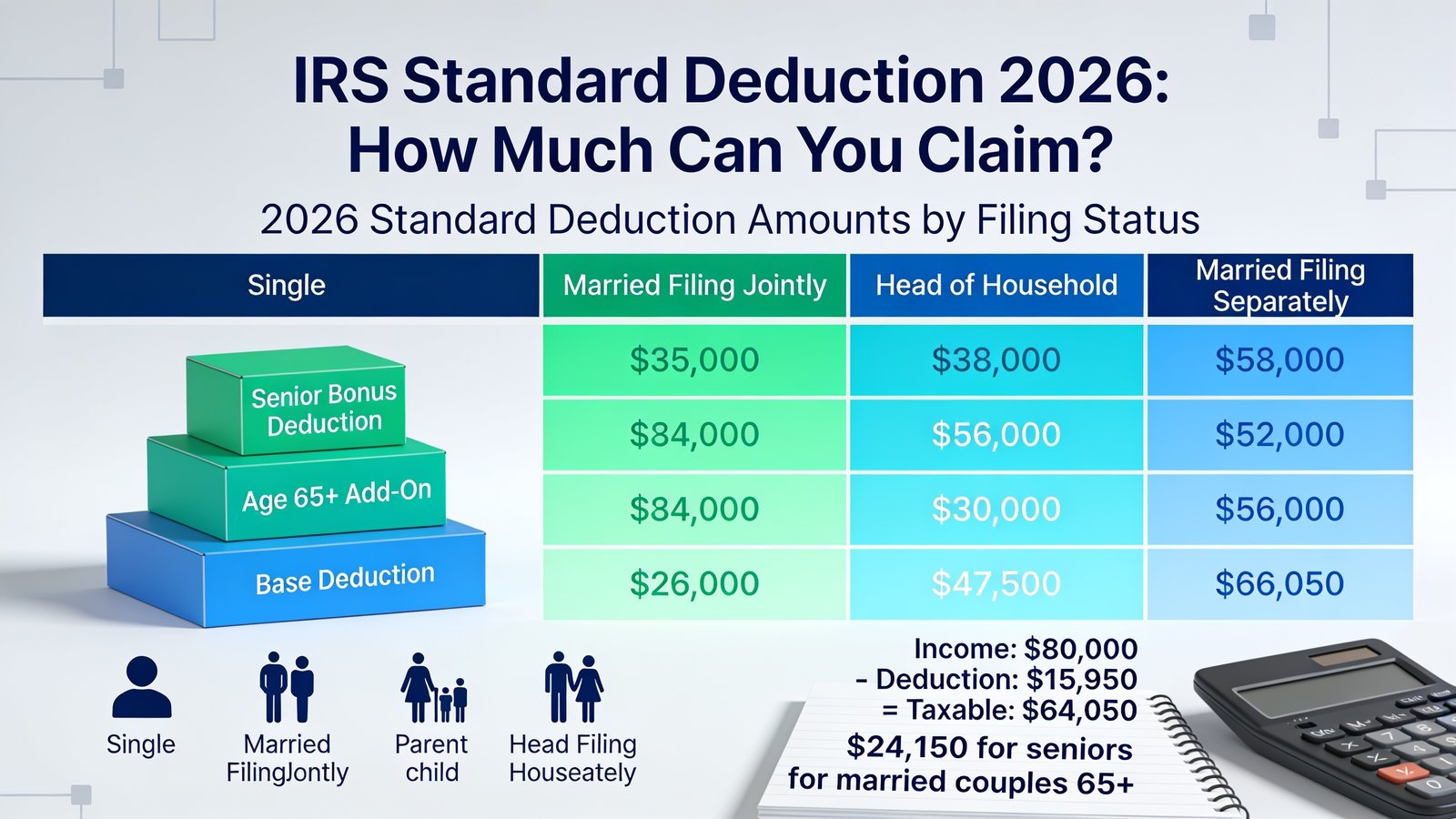
IRS Standard Deduction 2026: How Much Can You Claim? – The IRS standard deduction 2026 just got more interesting—and potentially more generous, especially if you’re over 65. This year, the amounts rose again thanks to inflation adjustments, and if you’re a senior, you’ve got multiple layers of deductions working in your favor.
Here’s why this matters: the standard deduction irs tax 2026 is the foundation of your entire tax calculation. It’s the amount you subtract from your gross income before any taxes apply. The bigger your deduction, the smaller your taxable income, and the less you owe. For most Americans—about 90%—taking the standard deduction is simpler and smarter than itemizing.
But the calculations have gotten more complex in 2026. You might be eligible for a base deduction plus an age-based add-on plus a brand-new temporary senior bonus deduction. Stacking these correctly could save you thousands. Let’s break down exactly how much you can claim.
What Is the Standard Deduction?
The standard deduction 2026 is a fixed dollar amount the IRS lets you subtract from your gross income if you don’t itemize deductions. Think of it as a tax-free earnings threshold.
When you file your return, you have two choices: take the standard deduction or itemize. Itemizing means you list out specific expenses (mortgage interest, property taxes, charitable donations, medical costs) to reduce taxable income. But if your itemized deductions don’t exceed your standard deduction, you’re better off taking the standard deduction—it’s simpler and gives you the same or better result.
The IRS adjusts the standard deduction 2026 annually for inflation, so the numbers change each year. This year’s adjustments were modest but meaningful, and they’re built into the calculations below.
2026 Standard Deduction by Filing Status
Your filing status determines your base standard deduction 2026. Here’s the full breakdown:
Single Filers
$16,100
If you’re unmarried and not filing as head of household or qualifying surviving spouse, your 2026 standard deduction is $16,100. This is an increase of $350 from 2025’s $15,750.
Example: You earn $50,000 in wages. Your taxable income = $50,000 − $16,100 = $33,900. That $33,900 is what gets taxed, not your full $50,000.
Married Filing Jointly (MFJ)
$32,200
Couples filing a joint return get $32,200 for 2026, up $700 from 2025. This is the largest standard deduction 2026 available and reflects the advantage of filing together.
Why the difference? The tax code gives married couples filing jointly wider brackets and higher standard deductions as an incentive to file together. If both spouses earned that $50,000 wage, combined $100,000 household income means a $32,200 deduction, leaving $67,800 taxable—much better than filing separately.
Married Filing Separately (MFS)
$16,100
If you file separately, each spouse gets $16,100—the same as a single filer. This filing status is rarely used because you lose many credits and deductions, but it’s an option if one spouse has business losses, significant education credits, or other circumstances make it worthwhile.
Head of Household
$24,150
If you’re unmarried but pay more than half the costs of maintaining a household for yourself and a qualifying dependent (usually a child or aging parent), you qualify for head of household status. Your 2026 standard deduction is $24,150, up $525 from 2025—a middle ground between single ($16,100) and married filing jointly ($32,200).
Qualifying Surviving Spouse
$32,200
This special status applies for up to two years after a spouse’s death. If you’re widowed in 2024 and file in 2025 and 2026, you get the married filing jointly standard deduction 2026 of $32,200.
Additional Deductions for Seniors (65+)
Here’s where it gets interesting. If you’re 65 or older or blind, you add a second deduction layer on top of your base standard deduction 2026.
Extra Deduction Amounts for 2026
Single or Head of Household:
- 65+ OR blind: add $2,050
- 65+ AND blind: add $4,100
Married Filing Jointly or Separately:
- One spouse 65+ OR blind: add $1,650
- Both spouses 65+ OR blind: add $3,300 (that’s $1,650 × 2)
- One spouse 65+ AND blind: add $3,300
- Both spouses 65+ AND blind: add $6,600
Example: Say you’re a single filer, age 68, with no vision loss. Your calculation is:
- Base standard deduction: $16,100
- Additional amount for age 65+: +$2,050
- Total standard deduction for 2026: $18,150
For married couples where both spouses are 65+:
- Base standard deduction: $32,200
- Additional amount (both spouses): +$3,300
- Total standard deduction for 2026: $35,500
Notice that these additions don’t depend on your income—they’re automatic if you qualify by age or blindness.
The New Senior Bonus Deduction (2025–2028)
Here’s the biggest recent change. Starting in 2025 and running through 2028, the government added an entirely new deduction for seniors age 65+. This is separate from the standard deduction and the age-based add-on.
How the Senior Bonus Deduction Works
Amount: Up to $6,000 per individual; $12,000 for married couples filing jointly, if both spouses qualify.
Catch: This deduction phases out if your modified adjusted gross income (MAGI) exceeds:
- $75,000 for single filers or heads of household
- $150,000 for married couples filing jointly
The phase-out rate is 6% for every dollar above the threshold, meaning if you’re $1,000 over the limit, you lose $60 of the deduction.
Key advantage: Unlike the standard and age-based deductions (which only work if you take the standard deduction), the senior bonus deduction is available whether you itemize or take the standard deduction.
Stacking the Deductions: The Maximum Picture
A 67-year-old single filer in 2026 with income below $75,000 could claim:
| Deduction Layer | Amount |
|---|---|
| Base standard deduction | $16,100 |
| Age 65+ add-on | +$2,050 |
| Senior bonus deduction | +$6,000 |
| Total | $24,150 |
For a married couple (both 65+) with income below $150,000:
| Deduction Layer | Amount |
|---|---|
| Base standard deduction | $32,200 |
| Age 65+ add-on (both spouses) | +$3,300 |
| Senior bonus deduction (both spouses) | +$12,000 |
| Total | $47,500 |
That $47,500 deduction means a couple could have nearly $48,000 of income completely untaxed before federal income tax even enters the picture.
Standard Deduction for Dependents
If someone else claims you as a dependent on their tax return, your IRS standard deduction 2026 is calculated differently—and it’s usually much smaller.
The Dependent Deduction Rule
You get the greater of:
- $1,350 (the flat minimum), OR
- Your earned income + $450 (capped at the regular standard deduction for your filing status)
Example 1: A 19-year-old college student with a part-time job earning $8,000 is claimed as a dependent. Her deduction: $8,000 + $450 = $8,450 (not $16,100, because her parents claim her).
Example 2: A high school student with a summer job earning $500 is claimed as a dependent. His deduction: $500 + $450 = $950… but wait—$950 is higher than the $1,350 floor, so he uses $950. Actually, let me recalculate: $500 + $450 = $950, which is less than $1,350, so he gets the floor of $1,350.
Key point: If you’re claimed as a dependent, you can’t use the full standard deduction 2026. This matters for teenagers with summer jobs or young adults in grad school claimed by parents.
Standard Deduction vs. Itemizing
When should you itemize instead of taking the standard deduction 2026? Only when your itemized deductions exceed your standard deduction.
When Itemizing Makes Sense
Itemized deductions include:
- Mortgage interest (up to $750,000 of mortgage debt)
- State and local taxes (SALT), capped at $10,000
- Charitable contributions
- Medical and dental expenses (over 7.5% of AGI)
- Property taxes
- Investment losses
If you’re married filing jointly with a $32,200 standard deduction 2026, you’d need itemized deductions totaling more than $32,200 to come out ahead. For most households, that’s a high bar—especially with the $10,000 SALT cap.
Real-world scenario: A couple in a high-tax state like California pays $15,000 in property tax and $8,000 in state income tax, but they hit the $10,000 SALT cap. They donate $5,000 to charity and have $3,000 in qualified medical expenses. Total itemized: $10,000 (SALT capped) + $5,000 (charity) + $3,000 (medical) = $18,000. Since $18,000 < $32,200, they take the standard deduction.
How to Claim Your Standard Deduction
You claim your standard deduction 2026 simply by entering the amount on your tax return—it’s one line on Form 1040.
On the form: The amount goes on Line 12 (Form 1040) or Line 3 (Form 1040-SR for seniors 65+). If you’re using tax software, it calculates and enters it automatically based on your filing status and age.
If you’re 65+: Make sure you tick the box that says you’re 65 or older. The software or IRS will automatically add the extra amount.
If you’re claiming the senior bonus deduction: This goes on a separate schedule (Schedule 1) with a slightly more detailed calculation based on your MAGI.
Common Mistakes & How to Avoid Them
Mistake 1: Not updating filing status after life changes.
You got married mid-year or became head of household. If you’re still using last year’s filing status, you might claim the wrong standard deduction 2026. Check your status every year.
Mistake 2: Forgetting the 65+ add-on.
Many seniors don’t realize they can add $2,050 (single) or $1,650 per spouse (MFJ) to their deduction. If tax software asks your age, use it—that’s how the system knows to add it automatically.
Mistake 3: Itemizing when you shouldn’t.
Some people itemize out of habit, not realizing their itemized deductions no longer exceed the standard deduction 2026. Run both calculations (standard vs. itemized) and pick the larger one.
Mistake 4: Overclaiming the senior bonus deduction.
The senior bonus phases out above $75,000 (single) or $150,000 (MFJ). If you’re above those thresholds, the deduction shrinks—you don’t lose it all, but it’s reduced by 6% of every dollar over the limit. Verify your MAGI before claiming the full amount.
2026 Changes from 2025
The IRS standard deduction 2026 saw several meaningful updates:
| Filing Status | 2025 | 2026 | Increase |
|---|---|---|---|
| Single | $15,750 | $16,100 | +$350 |
| Married filing jointly | $31,500 | $32,200 | +$700 |
| Married filing separately | $15,750 | $16,100 | +$350 |
| Head of household | $23,625 | $24,150 | +$525 |
The increases were driven by inflation adjustments. Notably, the One Big Beautiful Bill (enacted July 2025) increased 2025 amounts, and then 2026 saw additional inflation adjustments on top of that.
Key Takeaways
- The 2026 standard deduction is $16,100 (single), $32,200 (married filing jointly), $24,150 (head of household), or $16,100 (married filing separately)
- Seniors 65+ add $2,050 (single/head of household) or $1,650 per spouse (married)
- A new senior bonus deduction lets those 65+ claim up to $6,000 ($12,000 couples) in addition to the standard and age deductions (through 2028 only)
- Maximum senior deduction can reach $24,150 (single 65+) or $47,500 (married couple, both 65+)
- Dependents get only $1,350 or earned income + $450, whichever is greater
- The standard deduction 2026 increased across all statuses from 2025 due to inflation
- Blind taxpayers qualify for the same additional amounts as those 65+
Conclusion
The IRS standard deduction 2026 is your first line of defense against income tax. Taking the standard deduction is quick, simple, and best for most filers. If you’re 65 or older, the new layers of deductions—base deduction, age add-on, and the temporary senior bonus—mean you’re getting a substantial tax break through 2028.
Don’t leave money on the table by forgetting you qualify for extra deductions due to age or blindness. Run a quick calculation at the start of tax season: multiply your filing status by the base standard deduction 2026 amount, add any age/blindness adjustments, factor in the senior bonus if eligible, and that’s your starting point. Subtract that from your gross income, and you’ve got your taxable income. From there, the tax brackets apply.
The takeaway: know your number, claim it confidently, and keep more of your income.
IRS Standard Deduction 2026 FAQ
Q1: Will the standard deduction change after 2026?
A: Yes. The IRS adjusts it annually for inflation. The amounts you use depend on the tax year you’re filing—2026 amounts apply to income earned in 2026 (filed in 2027), 2027 amounts apply to 2027 income, and so on.
Q2: Can I claim both a dependent deduction and a senior bonus deduction?
A: No. If someone else claims you as a dependent, you can’t claim the senior bonus deduction. The dependent deduction ($1,350 or earned income + $450) replaces the standard deduction entirely if you’re claimed as a dependent.
Q3: What if I’m 65 and blind—do I get both extra amounts?
A: Yes. You add both the age add-on and the blindness add-on. For a single filer, that’s $2,050 + $2,050 = $4,100 extra (on top of the $16,100 base).
Q4: Does the senior bonus deduction apply if I itemize?
A: Yes, and this is huge. Unlike the standard and age deductions (which you only get if you take the standard deduction), the senior bonus is available even if you itemize. So a senior who itemizes can still claim up to the $6,000 bonus deduction.
Q5: My income is $80,000. Can I still claim the full $6,000 senior bonus?
A: Partially. The $6,000 phases out above $75,000 at 6% per dollar. Being $5,000 over the limit costs you 6% × $5,000 = $300. Your deduction: $6,000 − $300 = $5,700.
Q6: I got married in December 2026. Which filing status do I use?
A: You use married filing jointly for 2026 if you were married by December 31, 2026. Even one day into marriage counts. If you divorced in December, you’d file as single.
Disclaimer
This article provides general information about the 2026 IRS standard deduction and is based on guidance from the Internal Revenue Service and the Treasury Department as of August 2026. Tax laws are complex and individual circumstances vary widely.
This content is not personalized tax advice. Your specific standard deduction 2026 depends on your filing status, age, income, dependents, and other factors. Mistakes can be costly—either from overpaying or underpaying—so if your situation is complex (high income, dependents, self-employment, investments), consult a qualified tax professional: a Certified Public Accountant (CPA), Enrolled Agent (EA), or Tax Attorney.
The IRS website (irs.gov) provides the authoritative, up-to-date standard deduction amounts. For official information, see IRS Revenue Procedure 2025-32 or visit Publication 17 (Your Federal Income Tax).