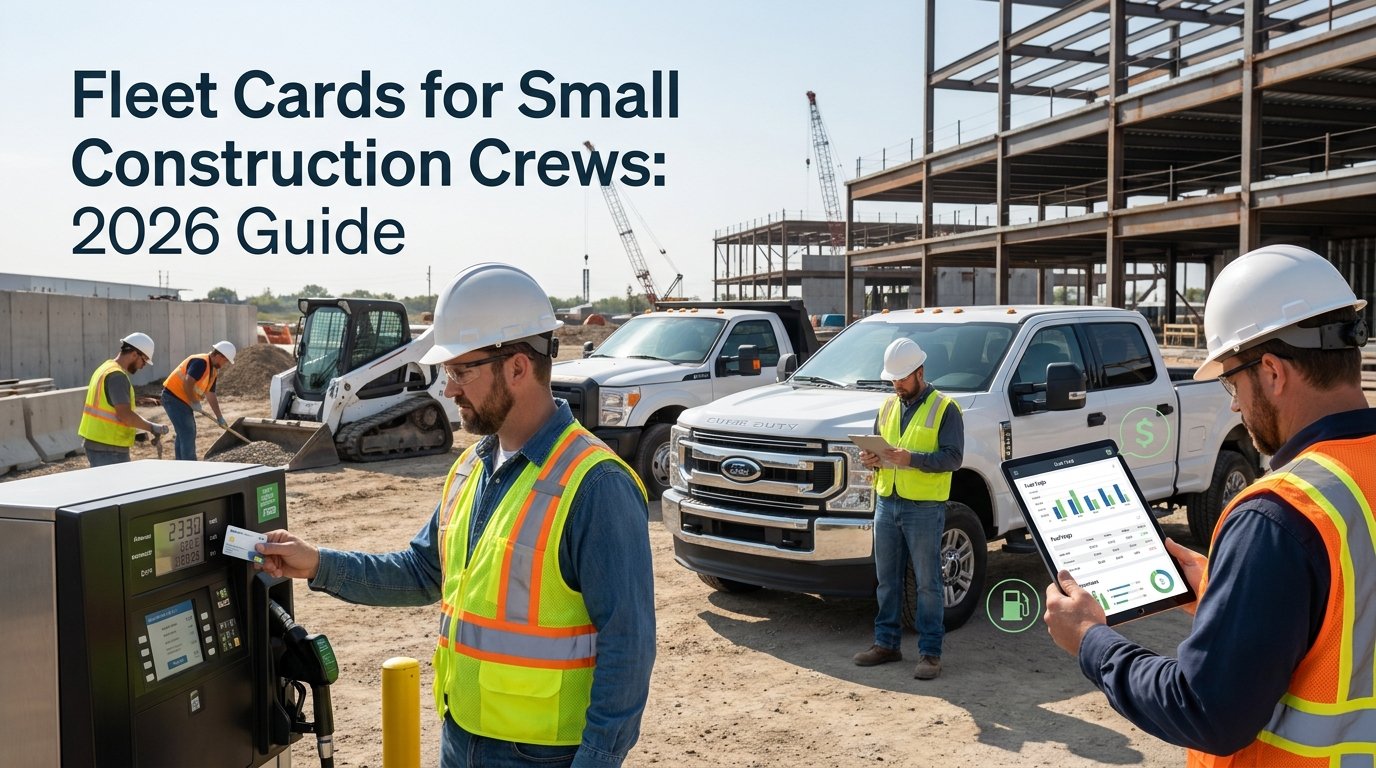
Fleet Cards for Small Construction Crews: What to Know in 2026- If you run a small construction company, fuel can quietly become one of your largest operating expenses. Your crew may drive pickup trucks between job sites, tow trailers, collect materials, and travel across several towns in a single week.
That makes fleet cards for small construction crews more than a way to pay for gasoline or diesel. The right card can help you control employee spending, organize fuel receipts, monitor purchases, and potentially reduce fueling costs.
But choosing a card based only on the advertised fuel discount can be a mistake. Fees, station coverage, spending controls, reporting tools, and your crew’s actual fueling habits can matter just as much. This guide explains what small construction businesses should look for when evaluating fleet cards in 2026.
What Is a Fleet Card?
A fleet card is a business payment card designed primarily for fuel and vehicle-related expenses. Unlike a general-purpose business credit card, fleet cards often provide tools that let business owners control and monitor how employees use company funds.
Depending on the program, you may be able to assign cards to individual drivers, vehicles, or employees. You can also find features such as transaction reporting, purchase restrictions, driver identification, and alerts.
For example, WEX says its small-business fuel cards can provide fuel controls, expense monitoring, fraud protection, reporting, and access to a large U.S. fueling network.
That can be useful when several employees are driving company vehicles.
Why Do Construction Crews Use Fleet Cards?
Construction businesses have a unique fuel challenge.
A crew might start the morning at the company yard, drive to a job site, stop for materials, travel to another project, and return home later that day. If several workers are doing this simultaneously, tracking fuel purchases through cash, personal cards, or receipts can become difficult.
Fleet cards can bring those transactions into one system.
1. Better fuel expense tracking
Instead of collecting scattered receipts, you can review fuel purchases by card, driver, or vehicle.
That gives the owner a clearer picture of where money is going.
2. Spending controls
Many fleet card programs allow business owners to establish limits or restrictions.
For example, you might restrict a card to fuel purchases or establish limits based on dollar amounts, time periods, or product types.
Some WEX programs specifically advertise purchase controls and transaction monitoring for small businesses.
3. Easier bookkeeping
A centralized transaction history can make it easier to reconcile fuel expenses with your accounting records.
That doesn’t eliminate your responsibility to maintain appropriate tax records, but it can reduce the amount of manual receipt tracking.
4. Potential fuel savings
Some cards provide rebates or discounts at participating stations.
However, the actual value depends on where your crew buys fuel and how much it purchases.
What Should You Look for in Fleet Cards for Small Construction Crews?
The best card isn’t necessarily the one with the biggest advertised rebate.
Instead, compare the entire program.
Station coverage
Start with a simple question:
Where does your crew actually buy fuel?
A card that offers excellent discounts at one fuel brand may be less useful if your crews regularly work in areas where those stations are unavailable.
Universal or broad-acceptance cards can provide greater flexibility.
For example, WEX currently says some of its small-business cards are accepted at a broad network of U.S. fueling locations, while its Shell Card Business program focuses savings around Shell locations.
Fuel discounts
Look at the actual discount structure.
Ask:
- Is the discount available everywhere or only at participating stations?
- Is it a rebate or an instant price reduction?
- Are there transaction fees?
- Does the discount apply to gasoline, diesel, or both?
- Are there volume requirements?
- Are certain locations excluded?
Read the current terms before assuming an advertised savings figure will apply to your business.
Spending controls
This feature can be particularly valuable for small crews.
Look for controls that let you manage:
- Fuel-only purchases
- Dollar limits
- Purchase frequency
- Driver identification
- Product restrictions
- Time-of-day restrictions
- Alerts for unusual transactions
These controls can help reduce unauthorized purchases.
Reporting
Good reporting can save administrative time.
Look for reports that show the date, location, amount, fuel type, driver, and vehicle associated with each transaction.
Some programs also provide online or mobile management tools.
Fees
Always calculate the total cost.
A card offering a large fuel discount may not be the cheapest option if it comes with significant monthly, annual, transaction, or network fees.
For example, Shell Card Business currently advertises no setup, monthly, or annual fees while offering savings at participating Shell locations.
Terms can change, so verify the current agreement before applying.
Fuel Discounts Aren’t the Whole Story
Suppose a card advertises a large per-gallon discount.
It sounds attractive.
But imagine your crew frequently fuels at stations outside that card’s preferred network. You might receive little of the advertised benefit.
Now consider another card with a smaller discount but much broader acceptance. If your drivers can consistently use it at convenient locations, the second option could produce better real-world savings.
That’s why you should calculate effective savings, not just advertised savings.
A simple comparison is:
Annual fuel savings − annual card fees = estimated net benefit
You can also consider administrative savings from better reporting and fewer manual receipts.
Fleet Cards vs. Business Credit Cards
A business credit card can be a perfectly reasonable option for a very small contractor.
However, fleet cards can provide specialized fuel-management features that general-purpose cards may not offer in the same way.
| Feature | Fleet Card | Business Credit Card |
|---|---|---|
| Fuel-focused controls | Usually strong | Varies |
| Driver restrictions | Often available | Varies |
| Fuel reporting | Usually detailed | Usually less specialized |
| Broad purchases | Depends on card | Usually strong |
| Rewards | Often fuel-focused | May cover many categories |
| Accounting tools | Often fleet-focused | General business tools |
| Fuel network discounts | May be available | Usually reward-based |
The right choice depends on how your company operates.
If you have one truck and you’re the only driver, simplicity may matter more. If you have several employees fueling company vehicles, specialized controls may become much more valuable.
A Real-World Example
Say you operate a small construction company with five pickup trucks.
Each truck travels regularly between job sites, suppliers, and the company yard. Five employees use the vehicles, and fuel purchases are currently made with a mixture of company cards and receipts.
Instead of choosing a fleet card solely because it advertises the biggest fuel rebate, you compare three things:
- Where your drivers actually buy fuel.
- How much fuel the company purchases each month.
- What fees and restrictions come with each card.
You discover that one card has a higher advertised discount but limited locations near several of your active projects. Another offers a smaller potential discount but much broader acceptance and stronger transaction controls.
For your company, the second card could be the more practical choice.
The lesson is simple: the best fleet card is the one that works with your actual routes and spending patterns.
Fleet Cards and Construction Equipment
Construction companies need to be especially careful when fuel is used for more than road vehicles.
Your business may operate:
- Excavators
- Skid steers
- Backhoes
- Generators
- Compressors
- Other diesel-powered equipment
Don’t automatically assume that a standard fleet card designed for road vehicles will handle every type of fuel purchase or equipment-related expense exactly the way you expect.
If your business uses off-road diesel or other specialized fuel arrangements, verify the card’s current rules before signing up.
You should also distinguish between fuel for highway vehicles and fuel used in equipment when maintaining business records.
A Common Mistake Small Contractors Make
One of the most common mistakes is choosing a fleet card because of its headline cents-per-gallon discount.
That number doesn’t tell you the whole story.
A contractor should also check station coverage, fees, purchase restrictions, reporting, payment terms, and whether the card fits the company’s fuel-buying patterns.
Another mistake is giving every employee unrestricted spending access.
Even trusted employees can make accidental purchases. Setting reasonable controls can provide an additional layer of protection.
Fleet Cards and Tax Recordkeeping
Fleet cards can make business fuel records easier to organize, but they don’t replace proper tax recordkeeping.
The IRS requires taxpayers to substantiate certain business transportation and travel expenses. The exact tax treatment depends on the business structure, vehicle, use, and accounting method.
There is also an important 2026 development to know about.
The IRS currently lists the business standard mileage rate at 76 cents per mile for July 1 through December 31, 2026, following a midyear adjustment related to higher fuel prices. The rate was 72.5 cents per mile for January 1 through June 30.
However, a construction company shouldn’t assume that the standard mileage method automatically applies to every company vehicle or piece of equipment.
Large work trucks and specialized construction equipment can involve different tax considerations.
Keep fuel invoices, receipts, mileage records, and other supporting documentation according to your tax professional’s guidance.
How to Choose a Fleet Card for Your Construction Business
Use this five-step process before applying.
Step 1: Calculate your fuel spending
Review several months of fuel purchases.
Find your average monthly gallons and spending.
Step 2: Map your common fueling locations
Identify the stations your crews actually use.
Don’t choose a card based on a network your drivers rarely encounter.
Step 3: Compare total costs
Look beyond fuel discounts.
Check:
- Monthly fees
- Annual fees
- Transaction fees
- Finance charges
- Network restrictions
- Additional card fees
Step 4: Review controls
Determine whether you can control spending by employee, vehicle, product, location, or transaction amount.
Step 5: Read the current terms
Fuel card offers can change.
Verify the current pricing, rebates, acceptance network, eligibility requirements, and account terms before applying.
Who Benefits Most From a Fleet Card?
Fleet cards can make the most sense for construction companies that have multiple vehicles or employees regularly purchasing fuel.
They’re particularly useful when:
- Several workers use company vehicles.
- Fuel receipts are difficult to track.
- Owners want tighter spending controls.
- Vehicles travel between multiple job sites.
- The company wants centralized fuel reporting.
- Fuel spending is large enough to justify comparing discounts.
For a one-person operation with a single vehicle, a conventional business payment card may be simpler.
Key Takeaways
- Fleet cards for small construction crews can simplify fuel management and spending oversight.
- Compare the entire program rather than focusing only on cents-per-gallon savings.
- Make sure the card’s fueling network matches your crews’ routes.
- Look for driver controls, purchase limits, alerts, and detailed reporting.
- Check all monthly, annual, transaction, and financing fees.
- Don’t assume a road-fuel card automatically suits off-road construction equipment.
- Maintain appropriate fuel, mileage, and business-use records.
- Verify current card terms before applying because offers and pricing can change.
Conclusion
For a growing contractor, fuel management can become surprisingly complicated. Multiple trucks, employees, job sites, and fuel receipts create opportunities for unnecessary spending and administrative headaches.
The right fleet cards for small construction crews can bring those expenses into one system while giving business owners more visibility and control.
Still, there isn’t one card that’s automatically best for every construction company. Start with your actual fuel spending, fueling locations, vehicle types, and crew size. Then compare fees, network coverage, controls, reporting, and potential savings.
That approach gives you a much better chance of choosing a fleet card that saves money and makes the business easier to manage.
Frequently Asked Questions
Are fleet cards worth it for a small construction company?
They can be, especially when multiple employees use company vehicles. The value depends on fuel volume, station coverage, fees, spending controls, and reporting features.
What should small contractors look for in a fleet card?
Look for broad station acceptance, competitive fuel pricing, low fees, spending controls, driver identification, transaction alerts, and useful reporting.
Can fleet cards be used for diesel?
Many fleet cards support diesel purchases, but acceptance and discounts vary by program. Verify the current terms and network before applying.
Can a fleet card be used for construction equipment?
It depends on the card and the type of fuel or equipment involved. Contractors using off-road equipment should confirm that the program supports their specific fueling needs.
Are fleet card expenses tax deductible?
Potentially, if the expenses qualify as ordinary and necessary business expenses. The tax treatment depends on the business and vehicle circumstances, so maintain supporting records and consult a qualified tax professional when needed.
Disclaimer:
This article is for general educational purposes and does not provide tax, legal, accounting, or financial advice. Fleet card pricing, discounts, acceptance networks, fees, and terms can change. Verify current terms directly with the card issuer before applying. Tax rules can also depend on your individual circumstances. Information about IRS mileage rates in this article reflects official IRS guidance available as of August 2026.