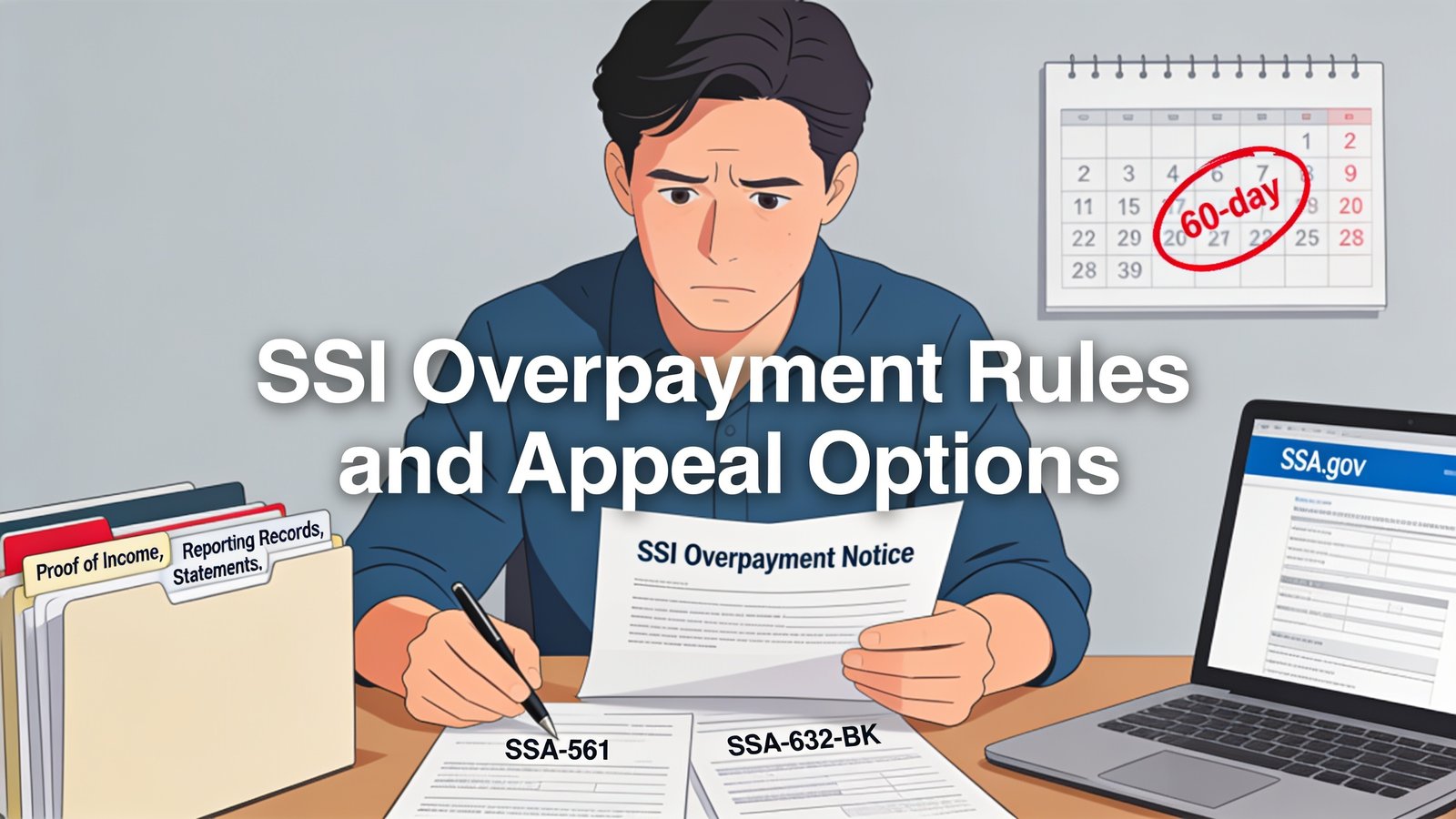
SSI Overpayment Rules and Appeal Options: What to Do When SSA Says You Owe Money: Getting a letter from Social Security saying you were “overpaid” can be terrifying, especially if you rely on SSI to cover basic needs. The language in those notices is formal and confusing, and it may feel like you have no choice but to pay back money you don’t have.
The good news: SSI overpayment rules and appeal options give you several ways to challenge the decision, ask for a different payment plan, or in some cases, avoid repayment entirely. As of August 2026, the Social Security Administration (SSA) has clear procedures for appeals and waivers, and you have rights in this process.
This guide walks you through what an SSI overpayment is, why it happens, your main appeal and waiver options, deadlines, forms, and practical tips so you can protect your benefits and reduce stress.
What Is an SSI Overpayment?
An SSI overpayment happens when the Social Security Administration pays you more SSI than you should have received under the law.
SSA will send you a written notice that explains:
- The amount they say you were overpaid
- The time period involved
- The reason for the overpayment
- How they plan to recover (take back) the money
- Your appeal and waiver rights
Overpayments are common with SSI because your benefit depends on your income, living situation, and resources, all of which can change from month to month.
Why SSI Overpayments Happen
Most SSI overpayments are caused by one of the following:
- Income changes you didn’t report on time (wages, gig work, unemployment, pensions, etc.)
- Changes in living arrangements (moving in with someone, getting married, changes in who pays the bills)
- Bank account balances or assets going over SSI limits
- SSA delay or error in processing information you did report
- Returning to work and SSA not updating your record quickly enough
Sometimes the overpayment is partly SSA’s fault and partly yours. That matters later when you ask for a waiver.
What Your Overpayment Notice Really Means
When SSA believes there’s an SSI overpayment, they send a notice asking you to refund the full amount, usually within 30 days. If you’re still getting SSI, they typically propose to:
- Withhold the lesser of 10% of your federal SSI payment or your entire monthly payment, starting in a specific month, if you don’t respond.
The notice should also explain:
- How to appeal (request reconsideration) if you think the overpayment is wrong
- How to request a waiver so you don’t have to pay it back
- How to ask for a lower repayment rate if you agree you owe the money but can’t afford the proposed withholding
This letter is your roadmap. Don’t ignore it.
SSI Overpayment Rules: Key Things to Know
Based on SSA guidance as of August 2026:
- You have the right to appeal if you think you were not overpaid or the amount is wrong.
- You usually have 60 days from the date you receive the notice to file an appeal (reconsideration).
- If you request reconsideration within that time and you’re still getting SSI, SSA will stop or delay recovery while they review your appeal.
- You can ask for a waiver at any time, even years later. There’s no deadline for a waiver request.
- To get a waiver approved, you generally must show:
- You were not at fault in causing the overpayment, and
- Paying it back would cause a financial hardship or be unfair in your situation.
- If SSA denies your waiver or reconsideration, you can usually appeal to higher levels, including a hearing before an Administrative Law Judge.
These SSI overpayment rules and appeal options give you more control than it might feel when you first open that letter.
Your Main SSI Appeal Options
You don’t have to pick only one route. You can:
- Appeal the fact or amount of the overpayment (reconsideration), and/or
- Ask for a waiver so you don’t have to repay, and/or
- Ask SSA to change the repayment rate so the monthly withholding is smaller.
Let’s break each one down.
5.1 Request a Reconsideration (Appeal the Overpayment)
Use this if you think:
- You were not actually overpaid, or
- The amount is wrong, or
- SSA is using the wrong dates or income information.
How to request reconsideration
- Fill out Form SSA‑561 (Request for Reconsideration), or send a written statement that clearly says you disagree with the overpayment.
- Explain why you think the decision is wrong and attach any proof (pay stubs, bank records, letters you sent SSA, etc.).
- Send or take the form to your local Social Security office.
Deadlines matter.
- You typically must file within 60 days from the date you receive the overpayment notice.
- SSA assumes you got the notice 5 days after the date on the letter, unless you show otherwise.
- If you’re late, you can still try, but you’ll need to show good cause (serious illness, homelessness, not understanding the notice, etc.).
If you request reconsideration on time and you’re still getting SSI, SSA usually stops recovery temporarily until they decide the appeal. If they agree with you, they’ll reduce or erase the overpayment.
5.2 Ask for a Waiver (So You Don’t Have to Repay)
Use this if:
- You agree the overpayment happened, but
- You believe it was not your fault, and
- You cannot afford to pay it back or think repayment would be unfair.
Under federal rules (20 C.F.R. § 416.550 and related sections), SSA can waive recovery when:
- You were without fault, and
- Repayment would:
- Defeat the purpose of SSI (you can’t meet basic needs like food, housing, clothing, medical care), or
- Be against equity and good conscience (unfair based on what happened), or
- In some cases, be not worth the administrative cost for very small amounts.
How to request a waiver
- Use Form SSA‑632‑BK (Request for Waiver of Overpayment Recovery).
- List your income, expenses, and assets to show hardship.
- Explain clearly why you were not at fault (for example, you reported changes, followed instructions, or relied on incorrect information from SSA).
- Submit it to your local SSA office.
For overpayments of $2,000 or less, SSA may be able to process some waiver requests more simply, sometimes even over the phone, especially if it’s clear you’re not at fault and can’t afford repayment.
A waiver request can be made at any time, even if you already started paying the money back.
5.3 Ask to Change the Repayment Rate
If you:
- Agree you were overpaid, and
- Don’t qualify for or don’t want a waiver, but
- Can’t afford SSA’s proposed withholding,
You can ask them to lower the monthly recovery amount.
How to request a lower rate
- Use Form SSA‑634 (Request for Change in Overpayment Recovery Rate).
- Show your monthly income and necessary expenses to prove hardship at the current rate.
- Offer a reasonable amount you can afford (for example, $25 or $50 a month).
SSA may agree to a smaller monthly deduction so you can still pay for essentials while repaying the overpayment.
How to Decide: Reconsideration vs. Waiver vs. Both
You do not have to choose just one. Many people do both.
Use this as a simple guide:
- You think SSA is wrong?
→ File a reconsideration (appeal the overpayment itself). - You agree there was an overpayment, but not your fault, and you can’t afford to repay?
→ Request a waiver. - You agree you owe the money and can pay something, just not the amount they want to take each month?
→ Request a change in repayment rate.
You can file a reconsideration and a waiver at the same time. SSA may treat a reconsideration of a very small overpayment (around $2,000 or less) as also being a request for waiver in some situations, but don’t rely on that—say clearly what you’re asking for.
Step‑by‑Step: How to Appeal an SSI Overpayment
Here’s a basic roadmap to follow when you open that letter.
Step 1: Read the notice carefully.
- Highlight the amount, dates, and reason for the overpayment.
- Mark the deadline to appeal (60 days from when you receive it for reconsideration).
Step 2: Decide what you believe is wrong.
Ask yourself:
- Do I think SSA miscalculated?
- Do I believe I wasn’t overpaid at all?
- Do I agree it happened but think I shouldn’t have to repay because it wasn’t my fault and I can’t afford it?
Your answers tell you whether you need reconsideration, a waiver, or both.
Step 3: Request reconsideration if you dispute the overpayment
- Fill out Form SSA‑561 or write a letter saying you want reconsideration of the SSI overpayment.
- Clearly explain your side: “I reported my wages on these dates,” or “The income you counted was not mine,” etc.
- Attach proof: pay stubs, reporting receipts, bank statements, letters from employers, and copies of reports you sent to SSA.
Step 4: Request a waiver if you can’t afford to repay and were not at fault.
- Fill out Form SSA‑632‑BK.
- List all your monthly income (SSI, small wages, and SNAP doesn’t count as income for this but be honest about your situation) and necessary expenses (rent, utilities, food, medical, and transportation).
- Show that you have little to no money left over each month.
- Explain why you were not at fault:
- You reported changes when required;
- You relied on SSA’s incorrect advice;
- You didn’t understand the rules due to a disability or limited education, and SSA didn’t explain clearly.
Step 5: Ask to lower the recovery rate if needed.
- If SSA is already taking money or plans to, and it’s too much, submit Form SSA‑634.
- Provide the same type of budget detail showing what you truly can afford.
Step 6: Keep copies and proof of everything.
- Make copies or take photos of every form and document you send.
- If you go in person, ask for receipts or date‑stamped copies.
- If you mail, consider certified mail so you have proof of delivery.
Step 7: Follow up with SSA
- Call SSA (1‑800‑772‑1213, TTY 1‑800‑325‑0778) to confirm they received your requests.
- Ask for status updates if you don’t hear back.
Common Mistakes to Avoid
One big mistake people make with SSI overpayment rules and appeal options is ignoring the notice because they feel overwhelmed or assume nothing can be done. That almost always makes things worse.
Other common missteps:
- Missing the 60‑day reconsideration deadline without asking for good cause.
- Not clearly stating that you’re asking for a waiver, so SSA treats it only as a repayment issue.
- Failing to show financial hardship with real numbers (income and expenses) on the waiver or repayment rate forms.
- Not keeping proof that you reported changes, making it harder to show you were not at fault.
Being proactive—even if you’re unsure—gives you the best chance of reducing or eliminating what you owe.
Example: How an SSI Overpayment Appeal Can Work in Real Life
Say you receive SSI and work a few hours a week at a local store. You report your wages using the SSI wage reporting app each month, and you keep the confirmation texts.
A year later, SSA sends you an overpayment notice saying you owe $3,200 because your wages were higher than they counted before. They want to withhold about 10% of your monthly check until it’s paid back.
Here’s what you could do:
- You disagree because you did report the wages every month. You file Form SSA‑561 within 60 days, attach screenshots of your reporting confirmations, and explain that SSA already had this information.
- At the same time, you file Form SSA‑632‑BK asking for a waiver, saying it’s not your fault if SSA delayed updating your record and that you can’t afford to repay without missing rent and food.
- While your requests are pending, SSA may pause recovery. If they agree you were not at fault and you can’t afford repayment, they can waive all or part of the $3,200.
This is a realistic scenario many people face, and it shows why it’s crucial to use the appeal and waiver tools available to you.
Expert Tips to Protect Yourself Going Forward
To reduce the risk of future overpayments:
- Report all changes quickly. Income, work hours, who you live with, marriage, and large gifts or inheritances all matter for SSI.
- Use written or electronic reporting when possible so you have records.
- Keep a simple folder—paper or digital—for:
- Wage reports and confirmation numbers
- Letters you send to SSA
- Copies of notices you receive
- Open every SSA letter right away and write the deadline on the envelope or at the top of the letter.
- If you’re confused, consider calling Legal Aid or a disability rights organization in your state for free help. Many are very familiar with SSI overpayment rules and appeal options.
Key Takeaways (Bullet Points)
- An SSI overpayment is when SSA pays you more SSI than the rules allow for a certain period.
- You have 60 days from when you receive the notice to request reconsideration if you think the overpayment is wrong.
- You can request a waiver at any time if you were not at fault and cannot afford to repay or repayment would be unfair.
- You can also ask SSA to lower the monthly repayment amount if their proposed withholding is too high.
- Using your appeal and waiver options early gives you the best chance to reduce or erase the debt.
- The most common mistake is ignoring the notice and missing appeal deadlines.
Conclusion
Facing an SSI overpayment can feel like the ground is shifting under your feet, especially when your benefits are your main source of income. But under current SSI overpayment rules and appeal options, you are not powerless. You can challenge the overpayment, ask for a waiver, or negotiate how much is taken from your check.
SSA’s own rules, as of August 2026, recognize that people on SSI often live right on the edge financially. If the overpayment wasn’t your fault and repayment would make it hard to afford basic needs, you may not have to pay it back at all. The key is to act quickly, stay organized, and use the reconsideration, waiver, and repayment tools that are there to protect you.
SSI Overpayment Rules and Appeal Options FAQ
1. What should I do first if I get an SSI overpayment notice?
Read the notice carefully, mark the 60‑day appeal deadline, and decide if you disagree with the overpayment or just can’t afford to repay. Then submit Form SSA‑561 (reconsideration), Form SSA‑632‑BK (waiver), or both as soon as you can.
2. Can SSA take my entire SSI check to recover an overpayment?
SSA generally proposes to withhold the lesser of 10% of your federal SSI benefit or your full check. If their plan would leave you unable to cover basic needs, use Form SSA‑634 to request a lower repayment rate and explain your budget.
3. What if I miss the 60‑day deadline to appeal an SSI overpayment?
You can still request reconsideration, but you’ll need to show good cause for filing late, such as illness, limited English, homelessness, or not understanding the notice. You can also request a waiver at any time, which does not have a strict deadline.
4. How do I prove I was “not at fault” in causing the overpayment?
Provide evidence that you followed SSA’s rules, such as wage reporting receipts, copies of letters you sent, or notes from phone calls. Explain any confusion, misunderstanding, or incorrect information you received from SSA that contributed to the overpayment.
5. Will requesting a waiver stop SSA from taking money out of my check?
Often, when you timely request a waiver or reconsideration, SSA will pause or adjust recovery while they review your case, especially if you’re still receiving SSI. Always ask the SSA representative to confirm how your request affects current withholding.
6. Can I both appeal the overpayment and ask for a waiver?
Yes. Many people file both a reconsideration (to challenge whether the overpayment is correct) and a waiver (to avoid repayment even if it is correct). Clearly label your forms so SSA knows you’re requesting both types of relief.
7. What if SSA denies my waiver request?
If SSA denies your waiver, you can appeal that denial, starting with reconsideration and, if needed, requesting a hearing before an Administrative Law Judge. Each appeal level has its own deadlines, so pay close attention to the dates on the decision letters.
8. Do these SSI overpayment rules and appeal options change often?
The basic structure—reconsiderations, waivers, and repayment plans—has been stable, but SSA policy details can evolve. Always check your latest SSA notice and, when possible, look at current guidance on SSA.gov or speak with a local advocate to confirm your rights based on the rules in effect as of the current month and year