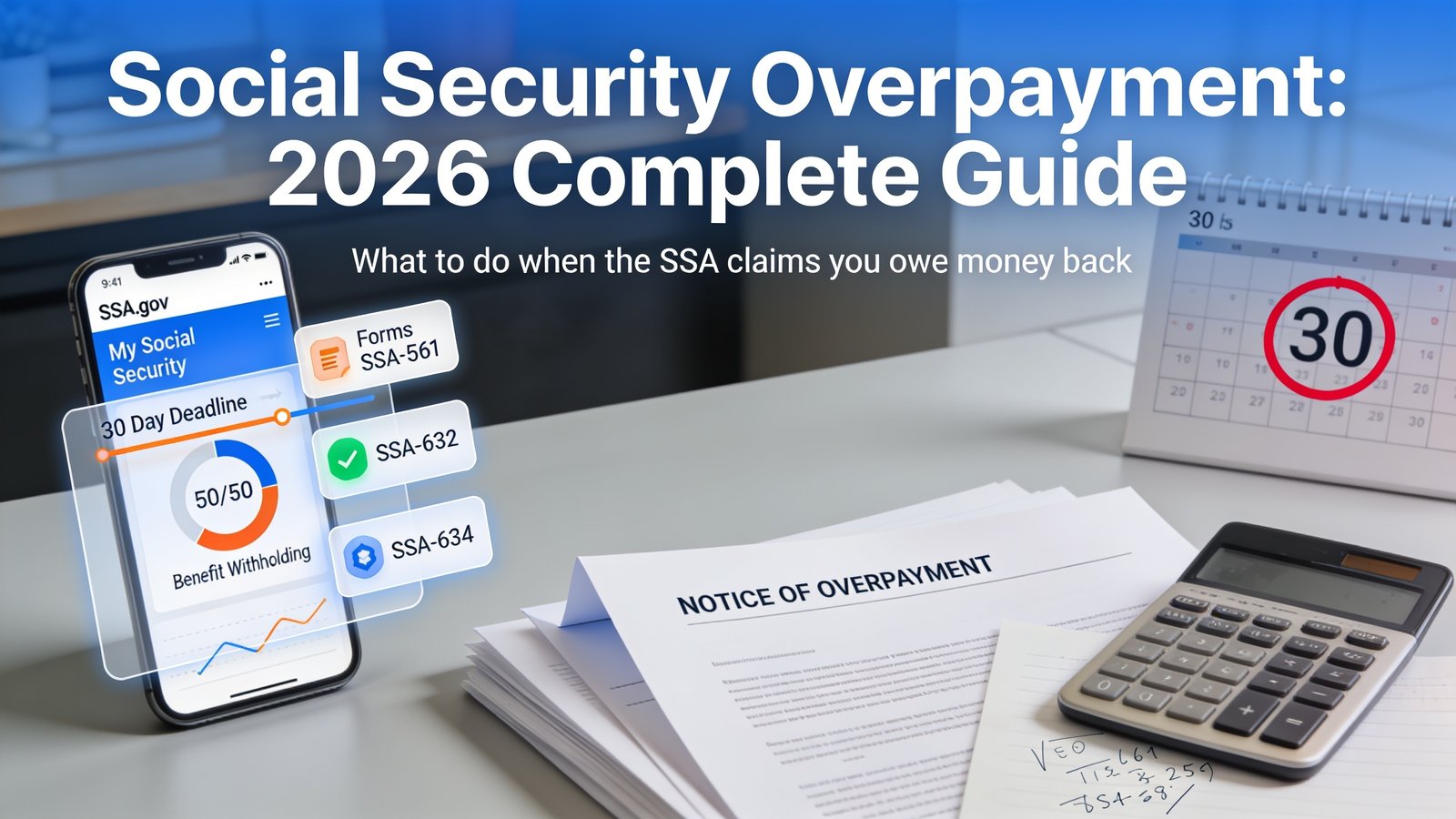
Social Security Overpayment Rules 2026 The Complete Guide: – Opening your mailbox to find a letter from the government demanding money back is a terrifying experience. If you recently received a notice claiming you received a Social Security overpayment, take a deep breath. You are not alone, and you have options.
The agency recently overhauled how it recovers money from beneficiaries. Understanding the latest rules is critical to protecting your monthly income. Based on IRS and SSA guidance and provisions as of August 2026, the timeline to respond is incredibly tight, and the financial consequences of missing a deadline are steeper than ever before.
This guide breaks down exactly what a Social Security overpayment is, how the aggressive new 50% withholding rule works, and the exact steps you can take right now to pause collection efforts, appeal the decision, or lower your monthly repayment.
What Exactly Is a Social Security Overpayment?
A Social Security overpayment happens when the Social Security Administration (SSA) pays you more money than you are legally entitled to receive for a given month.
This usually happens for a few specific reasons:
- You earned more income from working than the allowable limit before reaching your Full Retirement Age (FRA).
- Your living situation, marital status, or medical condition changed, but the agency did not update your file in time.
- The SSA simply made a clerical or mathematical error when calculating your monthly check.
When the agency discovers the error—sometimes years after the fact—federal law requires them to collect the extra money back. They initiate this process by sending you a formal Notice of Overpayment. This letter outlines how much you owe, why they believe you owe it, and the date by which you must repay the balance.
The 2026 Clawback Rule: The 50% Default Withholding
For years, if you owed the SSA money and failed to respond to their letters, the default penalty was a 10% reduction of your monthly check. Recent policy shifts have completely changed that dynamic.
As of the new rules finalized in late 2025 and fully enforced in 2026, the default withholding rate for Title II benefits (which include traditional retirement, survivors, and Social Security Disability Insurance) is now a massive 50% of your monthly benefit.
If you do not take action, the agency will automatically slice your check in half every single month until the entire debt is satisfied.
There is one major exception. If you receive Supplemental Security Income (SSI), the government recognizes that you are already living on a strictly limited, need-based income. For SSI recipients, the maximum default withholding remains capped at 10% of your monthly check (or $10, whichever amount is greater).
The 30, 60, and 90-Day Deadlines You Cannot Miss
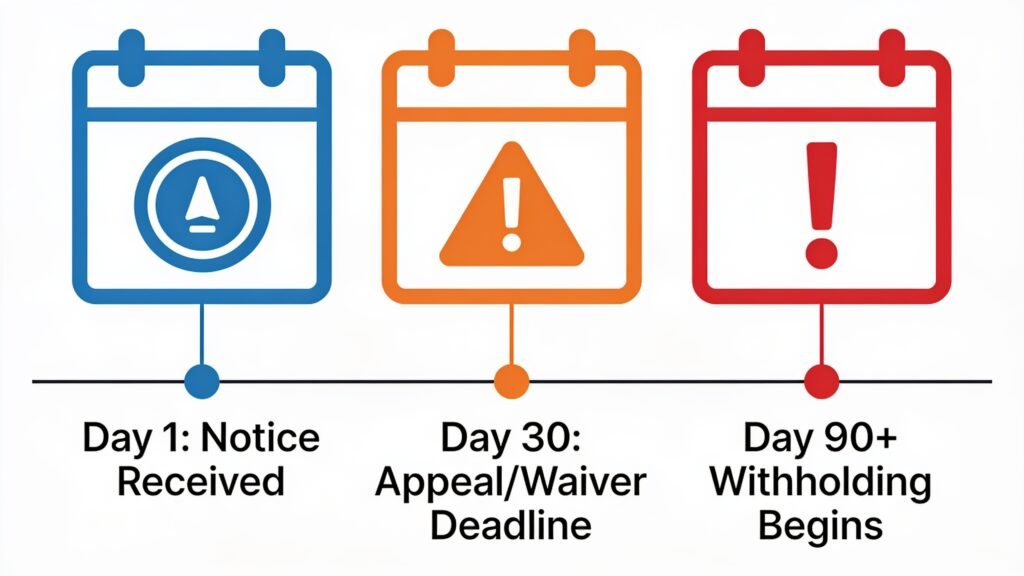
When you receive a demand letter, the clock immediately starts ticking. The SSA operates on very strict timelines, and missing them hands the agency permission to start taking your money.
Here is your timeline:
- The 30-Day Window: You have 30 days from the date on your notice to file an appeal or request a waiver. Doing so legally freezes all collection actions. The SSA cannot touch your check while they review your paperwork.
- The 60-Day Window: If you believe the agency is completely wrong and you do not owe the money, you have a maximum of 60 days to file a formal Request for Reconsideration.
- The 90-Day Window: If you do absolutely nothing, the SSA gives you a roughly 90-day grace period from the date of the notice. Once day 91 hits, the automatic 50% withholding begins without any further warning.
Real-World Example: How the 2026 Earnings Limit Triggers Debt
Many retirees unintentionally trigger a debt by working part-time before they reach full retirement age.
Say you’re a single filer who decided to claim early retirement benefits at age 62. You realize you need a bit more cash, so you pick up a part-time consulting gig in 2026, earning $32,480 for the year.
Because you have not yet reached your full retirement age, you are subject to the annual earnings test. For 2026, the earnings limit is $24,480.
The SSA penalizes you $1 for every $2 you earn above that limit.
- Your earnings: $32,480
- 2026 Limit: $24,480
- Overage: $8,000
Because you went $8,000 over the limit, the SSA will withhold $4,000 of your benefits. If they don’t catch your extra income until the following year when your tax return processes, they will send you an overpayment notice demanding that you back $4,000.
(Note: The withheld money isn’t gone forever. Once you reach Full Retirement Age, the SSA recalculates your benefit amount upward to account for the months they withheld cash.)
How to Fight or Lower Your Social Security Overpayment
You have three specific avenues to handle this situation. The path you choose depends on whether you agree with the agency’s math and your current financial situation.
1. File an Appeal (Form SSA-561)
Use Form SSA-561 (Request for Reconsideration) if you believe the SSA is entirely wrong. Maybe they counted income from a spouse you are divorced from, or they misread a tax document.
Filing this form means you are telling the agency, “I do not owe this money, and your calculations are incorrect.” You must provide documentation, such as W-2s, tax returns, or bank statements, to prove your case. File this within the first 30 days to pause the 50% withholding, though you technically have up to 60 days to submit it.
2. Request a Waiver (Form SSA-632)
Use Form SSA-632 (Request for Waiver of Overpayment Recovery) if you agree that the agency overpaid you, but you believe it was absolutely not your fault, and paying it back would cause you severe financial hardship.
To get an approval here, you have to prove two things:
- You did not cause the error (e.g., you reported your income changes on time, but the SSA failed to update their system).
- You cannot afford to pay for basic living expenses (food, rent, utilities, medicine) if they take the money back.
You can file this waiver at any time. The moment you file it, the SSA must pause all collection efforts until they make a decision. The SSA often automatically grants waivers for amounts under $1,000, but you still have to submit the form to get that forgiveness.
3. Negotiate a Lower Rate (Form SSA-634)
Use Form SSA-634 (Request for Change in Overpayment Recovery Rate) if you admit you owe the debt, but you simply cannot survive a 50% cut to your monthly check.
This form allows you to offer a more reasonable repayment plan. You can request a rate as low as $10 per month. The form acts as a detailed financial statement. You will need to list your monthly income, rent or mortgage, utility bills, food costs, and medical expenses to prove why the 50% rate is a hardship. As long as your proposed payment plan allows you to pay off the debt within 60 months, the SSA is highly likely to approve it.
The Most Common Mistake Beneficiaries Make
The single most destructive mistake beneficiaries make regarding a Social Security overpayment is simply ignoring the letter.
Many people assume the notice is a scam, or they feel so overwhelmed by the dense government jargon that they throw the envelope in a drawer hoping the problem will magically resolve itself. It won’t.
Ignoring the letter forces the SSA’s automated system to take over. Once that 90-day window closes, the system will relentlessly pull 50% of your check. Reversing the withholding after it has already started is incredibly difficult and takes months of administrative red tape. Open your mail immediately and take action the same week.
Proactive Steps to Protect Your Future Benefits
You can take control of your records to prevent these letters from showing up in the first place.
- Create an Online Account: Go to SSA.gov and set up your “My Social Security” account. This digital dashboard lets you track your earnings record, view your upcoming benefit amounts, and spot notices before they even arrive in the physical mail.
- Report Changes Immediately: If you are on SSDI or SSI, you must report changes to your income, marital status, or living arrangements by the 10th day of the following month. Call the SSA or update your file online.
- Use the Dedicated Phone Line: If you need to speak to someone about a debt, do not just call the general hotline. The SSA has a dedicated overpayment repayment line at 1-855-878-8071. (If you are deaf or hard of hearing, the TTY number is 1-800-325-0778).
Key Takeaways
- The penalty is severe: In 2026, the SSA defaults to taking 50% of your monthly benefit to recover debts (10% for SSI recipients).
- Speed is everything: You have exactly 30 days from the date of your notice to file an appeal or a waiver to automatically pause the clawback.
- You can negotiate: If you cannot afford the 50% cut, use Form SSA-634 to establish a manageable monthly payment plan, sometimes as low as $10 a month.
- Keep records: Always submit your forms via certified mail with a return receipt, or get a stamped copy directly from your local SSA office.
- Never ignore the notices: The government will eventually collect the money. Acting early gives you the power to dictate how the repayment happens.
Conclusion
Dealing with a Social Security overpayment can feel incredibly stressful, but the system does have built-in safety valves designed to protect you from financial ruin. By acting quickly, understanding the new 50% rule, and using the correct forms to assert your rights, you can protect your livelihood. Never let the sheer weight of government bureaucracy intimidate you into giving up half of your monthly check without a fight. Read your notices carefully, file your paperwork within the 30-day window, and reclaim control of your financial future.
Frequently Asked Questions (FAQs)
Can I go to jail for a Social Security overpayment?
No, you cannot go to jail for a standard overpayment caused by a clerical error, a misunderstanding of the earnings limit, or a failure to report a life change on time. It is treated as a civil debt. Criminal charges only arise in rare cases of intentional, orchestrated fraud (like cashing checks for a deceased relative).
What happens if I die before paying back the SSA?
If you pass away with an outstanding balance, the SSA will attempt to recover the funds from your estate. If your estate has no assets, the debt is generally wiped out. The agency will not force your children or heirs to pay the debt out of their own personal pockets.
Does the 50% withholding rule apply to SSI recipients?
No. Supplemental Security Income (SSI) is a specialized program for individuals with extremely limited income and resources. By law, the SSA caps SSI overpayment withholding at a maximum of 10% of your monthly benefit, or $10, whichever is greater.
How do I know if the overpayment notice is real or a scam?
Scammers frequently pose as the SSA. A real notice will come via U.S. Mail, clearly explain the reason for the debt, and provide official instructions for appealing. The real SSA will never call you demanding payment via wire transfer, cryptocurrency, prepaid debit cards, or gift cards. If you are unsure, log into your official SSA.gov account to verify the debt.
I filed a waiver 3 months ago and haven’t heard back. Will they start taking my money?
As long as you filed your waiver (Form SSA-632) within the allowed timeframe, the SSA is legally required to freeze all collection activities until they make a formal, written decision on your case. Processing times can take several months. Keep a copy of your filed form as proof.
Where can I get the forms to fight the overpayment?
All necessary forms (SSA-561, SSA-632, and SSA-634) are available to download and print for free under the “Forms” section on the official SSA.gov website. You can also call the SSA directly and ask a representative to mail you physical copies.
Disclaimer:
This article is provided for informational and educational purposes only and does not constitute legal, financial, tax, or professional advice. For guidance specific to your individual situation, consult a qualified Social Security attorney or financial professional, or contact the Social Security Administration (SSA) directly at 1-800-772-1213 or through its official website. The rules, benefit amounts, limits, and other information mentioned in this article reflect the applicable 2026 standards available at the time of publication and may change in the future. While we make reasonable efforts to keep the information accurate and up-to-date, our website Captain America does not guarantee the completeness, accuracy, or continued applicability of the information and is not responsible for any errors, omissions, or changes that may occur after publication. Readers should verify important information with official government sources before making financial, legal, or retirement decisions.