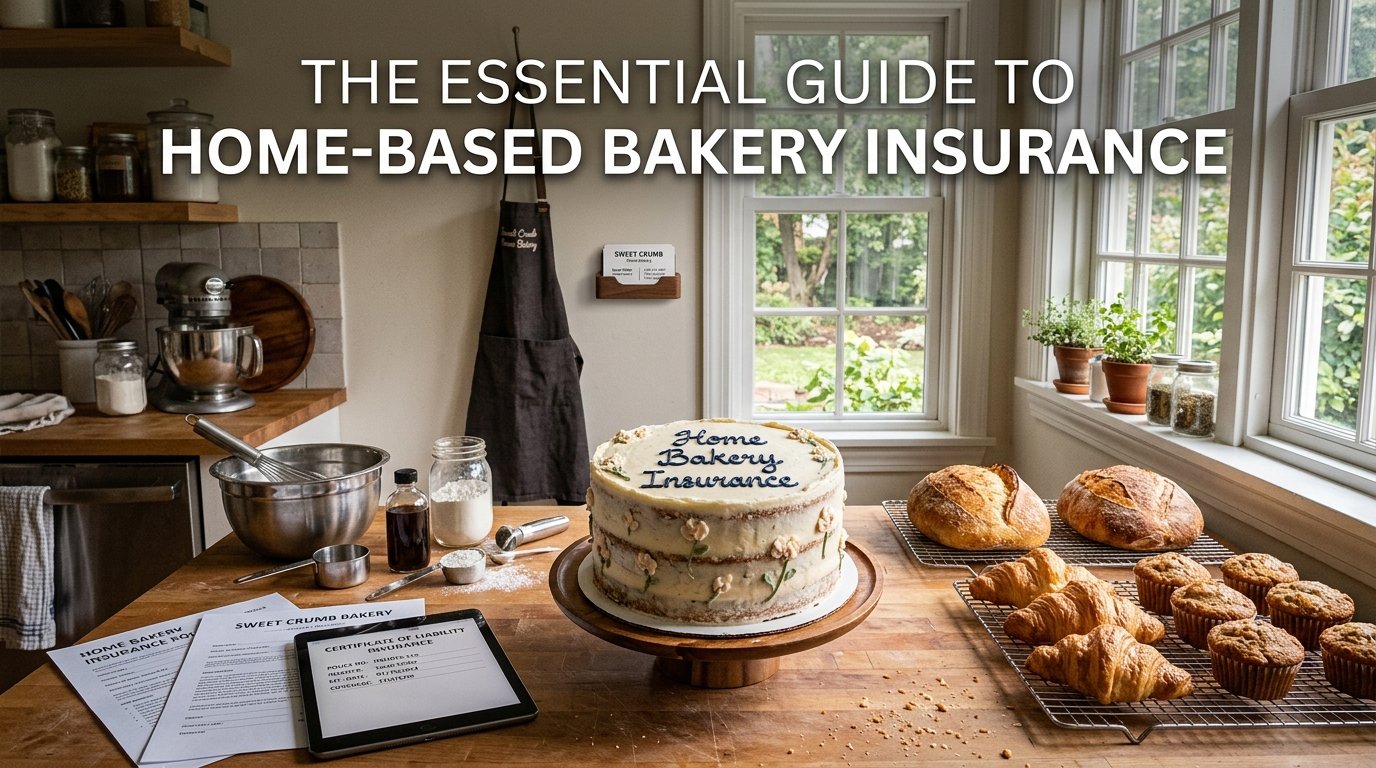
The Essential Guide to Home-Based Bakery Insurance: Protecting Your Sweet Dreams- Picture this: you’ve just perfected your grandmother’s sourdough recipe, your kitchen smells like freshly baked cinnamon rolls, and customers are raving about your custom-decorated cupcakes. Your home-based bakery business is taking off — but have you thought about what would happen if someone got sick from your baking, or a customer slipped on your porch during pickup?
That’s where home-based bakery insurance comes in. Think of it as the safety net that protects your sweet venture from unexpected disasters. In 2026, with the cottage food industry booming and more people than ever starting home-based baking businesses, understanding your insurance options isn’t just smart — it’s essential for protecting both your business and your personal assets.
Whether you’re selling at local farmers markets, taking custom cake orders, or shipping your famous cookies across the country, this guide will walk you through everything you need to know about insuring your home bakery business.
Understanding Cottage Food Laws and Insurance Requirements
First things first: what does the law actually say about insurance for home bakers? As of 2026, all 50 states have some form of cottage food laws that allow individuals to produce and sell certain homemade food products from residential kitchens. But here’s the catch — these laws don’t always require insurance.
Most states don’t mandate insurance for direct-to-consumer sales from your home. However, the moment you step into a farmers market or try to sell wholesale to a local café, you’ll likely need proof of liability insurance. Many farmers markets require vendors to have at least $1 million in general liability coverage before you can set up your stand.
The good news? Even when insurance isn’t legally required, it’s surprisingly affordable. A basic general liability and product liability policy typically costs between $200 and $500 per year — that’s less than many bakers spend on vanilla extract annually.
The Different Selling Scenarios
Let’s break down insurance requirements by where and how you sell:
- Direct sales from home: Rarely required by law but strongly recommended
- Farmers markets: Often required — many require $1 million in general liability
- Wholesale to stores or cafes: Almost always required by retailers
- Online sales and delivery: Varies by state — check your specific cottage food laws
- Custom orders (wedding cakes, special events): Highest risk for allergen-related claims
Types of Insurance Every Home Baker Should Consider
General Liability Insurance
This is your bread-and-butter coverage — no pun intended. General liability insurance protects you from third-party claims related to:
- Bodily injury (someone slips on your porch while picking up an order)
- Property damage (a delivery driver damages a customer’s property)
- Personal injury (someone claims your marketing copy damaged their reputation)
For most home bakers, general liability coverage is the most important type of protection. It typically costs between $25 and $65 per month, depending on your location, revenue, and coverage limits.
Product Liability Insurance
This is specific to food businesses and covers claims that your baked goods made someone sick or triggered an allergic reaction. Say someone with a severe nut allergy consumes your almond biscotti thinking it’s walnut-free — product liability would cover the medical expenses and legal fees if they filed a claim.
Business Property Insurance
While your homeowner’s policy might cover your personal belongings in the home, it likely excludes business equipment. If your $1,200 commercial mixer gets damaged or your inventory of rare vanilla beans gets destroyed, business property insurance would cover these losses.
Other Coverage Options to Consider
- Commercial auto insurance if you deliver orders
- Workers compensation if you hire employees (legally required in most states with employees)
- Business interruption insurance if a fire or other disaster prevents you from operating
How Much Does Home Bakery Insurance Really Cost?
Let’s talk numbers — because this is where many home bakers get pleasantly surprised. As of 2026, most home bakers pay between:
- $17 to $42 per month for general liability and product liability coverage
- $200 to $500 per year for basic general liability insurance
- $300 to $600 per year for comprehensive coverage through providers like Hiscox
The exact amount depends on several factors:
- Your state’s insurance regulations
- Your annual revenue (higher revenue typically equals higher premiums)
- Your coverage limits ($1 million vs. $2 million per occurrence)
- Whether you have employees
- What type of products you sell (allergen-heavy items may increase premiums)
A Practical Example
Say you’re a home baker in Texas selling artisan sourdough at two local farmers markets. You gross $35,000 annually. Through a provider like FLIP (Food Liability Insurance Program), you’d pay about $299-$399 per year — roughly $25-$33 per month. That gets you $1 million in general liability coverage with product liability protection included.
State-by-State Insurance Requirements: What You Need to Know
Insurance requirements vary widely across the United States. Here are a few examples of how different states handle cottage food insurance as of 2026:
- Texas: No revenue cap, no permit required, but many farmers markets require insurance
- Wyoming: No revenue cap, no permit, but labeling requirements are strict
- California: Requires registration with county health departments
- Colorado: Mandatory food safety training but no insurance requirement for direct sales
- Oregon: Registration required, revenue caps can limit growth
- Illinois: Complex requirements heavily dependent on sales channels
The trend in 2026 is toward more permissive laws, with states like Wyoming and Texas leading the charge with no revenue caps and minimal bureaucratic hurdles. However, even in the most freedom-friendly states, insurance remains a smart business decision.
Research Your State
Before you buy insurance or start selling, research your state’s specific cottage food laws. Download the regulations from your state’s department of agriculture or health. Key questions to answer:
- What products are allowed?
- Is there a revenue cap?
- Do you need to register or obtain a permit?
- What labeling requirements exist?
- Are online sales and deliveries permitted?
Choosing the Right Insurance Provider
Not all insurance companies understand the unique needs of home bakers. Here are some providers specializing in cottage food business insurance as of 2026:
FLIP (Food Liability Insurance Program)
- Cost: $299-$399 per year
- Best for: Cottage food and farmers market vendors
- Key features: Instant certificate of insurance, easy online application, specialized food business coverage
Next Insurance
- Cost: $200-$500 per year
- Best for: Small food businesses with growth plans
- Key features: Monthly billing, customizable coverage, excellent online platform
Hiscox
- Cost: $300-$600 per year
- Best for: Home-based businesses wanting broader coverage
- Key features: Includes general liability and professional liability options
What to Look for in a Provider
- Experience with food businesses
- Quick certificate of insurance issuance
- Flexible payment options (monthly vs. annual)
- Good customer service ratings
- Clear policy documentation
Common Insurance Mistakes Home Bakers Make
Mistake #1: Assuming Homeowners Insurance Covers Business Activities
This is the #1 mistake new home bakers make. Most homeowner’s and renter’s insurance policies explicitly exclude business activities. Read your policy carefully or talk to your insurance agent — you likely have zero coverage for business-related incidents.
Mistake #2: Underestimating Product Liability Risks
Allergens are no joke. If your “nut-free” cookie accidentally contains almond flour and someone has an anaphylactic reaction, you could be looking at five-figure medical bills. Product liability insurance covers these exact scenarios.
Mistake #3: Not Getting Certificates of Insurance When Needed
A certificate of insurance is a one-page document proving you have coverage. Farmers markets, event venues, and wholesale clients will ask for it constantly. Don’t wait until they ask — have digital copies ready to send.
Mistake #4: Setting Low Coverage Limits
While $500,000 in liability coverage might sound like a lot, medical costs add up quickly. Most experts recommend at least $1 million per occurrence coverage, with $2 million aggregate for the policy period.
Real-World Example: Baking Your Way to Protection
Let me introduce you to Maria, a home baker in Atlanta specializing in custom wedding cakes. In early 2026, Maria invested $350 in a general liability policy through Next Insurance.
A few months later, while delivering a three-tier wedding cake to a venue, her assistant slipped on a wet floor and broke both the cake and her wrist. The venue claimed Maria’s team caused the accident. The medical bills and replacement cake totaled $8,500.
Because Maria had insurance, her $1 million per occurrence policy covered all expenses after her $500 deductible. Without insurance, she would have faced legal fees, medical costs, and potentially lost her business.
The moral? Maria’s annual insurance premium was less than the cost of one damaged wedding cake — proving that insurance isn’t just about catastrophic events; it’s about protecting your business from everyday risks.
Key Takeaways
- Insurance isn’t always required by cottage food laws, but it’s smart business practice in any state.
- General liability insurance typically costs $200-$500 annually and protects you from third-party claims.
- Product liability coverage is essential for food businesses dealing with allergens and food safety concerns.
- Homeowners insurance rarely covers business activities — don’t assume you’re protected.
- Farmers markets and wholesale clients often require $1 million in liability coverage.
- Insurance costs scale with revenue — expect to pay more as your business grows.
- Certificates of insurance are necessary documents you’ll need frequently.
- Research your state’s cottage food laws before buying insurance or starting sales.
Conclusion
Starting and running a home-based bakery is an exciting venture combining creativity, entrepreneurship, and good old-fashioned deliciousness. But as your business grows from a hobby to a serious enterprise, protecting it becomes increasingly important.
Think about home-based bakery insurance as your business’s essential ingredient — the yeast that helps your venture rise safely. At $20-$40 per month for most basic policies, insurance is one of the most affordable investments you can make in your business’s future.
Remember that as of 2026, the bakery industry continues to flourish, with the retail bakery market recording $6.1 billion in revenues and growing faster than the broader economy. This growth means more opportunities — and more competition. Having proper insurance not only protects you from risks but also makes your business more professional and trustworthy to customers and partners.
Whether you’re just starting with a simple farmers market stand or building a full-blown custom cake business from your kitchen, take the time to get properly insured. The peace of mind alone is worth every penny, and the financial protection could save your business — and your personal assets — from unexpected disaster.
FAQ
Q1: Do I need a business license to get home bakery insurance?
A: Not always. Many insurers like FLIP and Next Insurance issue policies to cottage food operators without formal business licenses. However, having a registered business (even a simple sole proprietorship) can streamline the process and potentially qualify you for better rates. Always check your state’s specific requirements first.
Q2: How long does it take to get bakery insurance?
A: For most online providers specializing in cottage food businesses, you can get coverage in as little as 10-15 minutes. Providers like FLIP offer instant certificates of insurance, and you can often start a policy the same day you apply.
Q3: What’s the difference between general liability and product liability insurance?
A: General liability covers “slip and fall” type incidents — if a customer gets injured on your property or during delivery. Product liability specifically covers claims related to your food products making someone sick or having an allergic reaction. Many policies bundle both types of coverage together.
Q4: Do I need commercial auto insurance for deliveries?
A: If you’re making deliveries for your business, yes — personal auto insurance typically excludes business use. Even occasional deliveries can void your personal policy if an accident occurs while delivering baked goods. Commercial auto adds about $50-$150 per month to your insurance costs.
Q5: What happens if I exceed my state’s cottage food revenue cap?
A: If you hit your state’s revenue limit, you’ll need to transition to a commercial kitchen and obtain proper commercial business licenses and insurance. Your home bakery insurance might not cover commercial-scale operations, so consult with your provider about coverage changes needed for growth.
Disclaimer
This article provides general information about home-based bakery insurance as of August 2026. Insurance requirements, laws, and regulations vary by state and are subject to change. The information presented here does not constitute legal or professional insurance advice. Always consult with licensed insurance professionals, legal counsel, and state regulatory agencies to understand the specific requirements applicable to your business. Individual insurance premiums and coverage details will vary based on your location, business size, products sold, and risk factors. Recommendations for specific insurance companies are based on publicly available information as of 2026 and do not constitute endorsements.