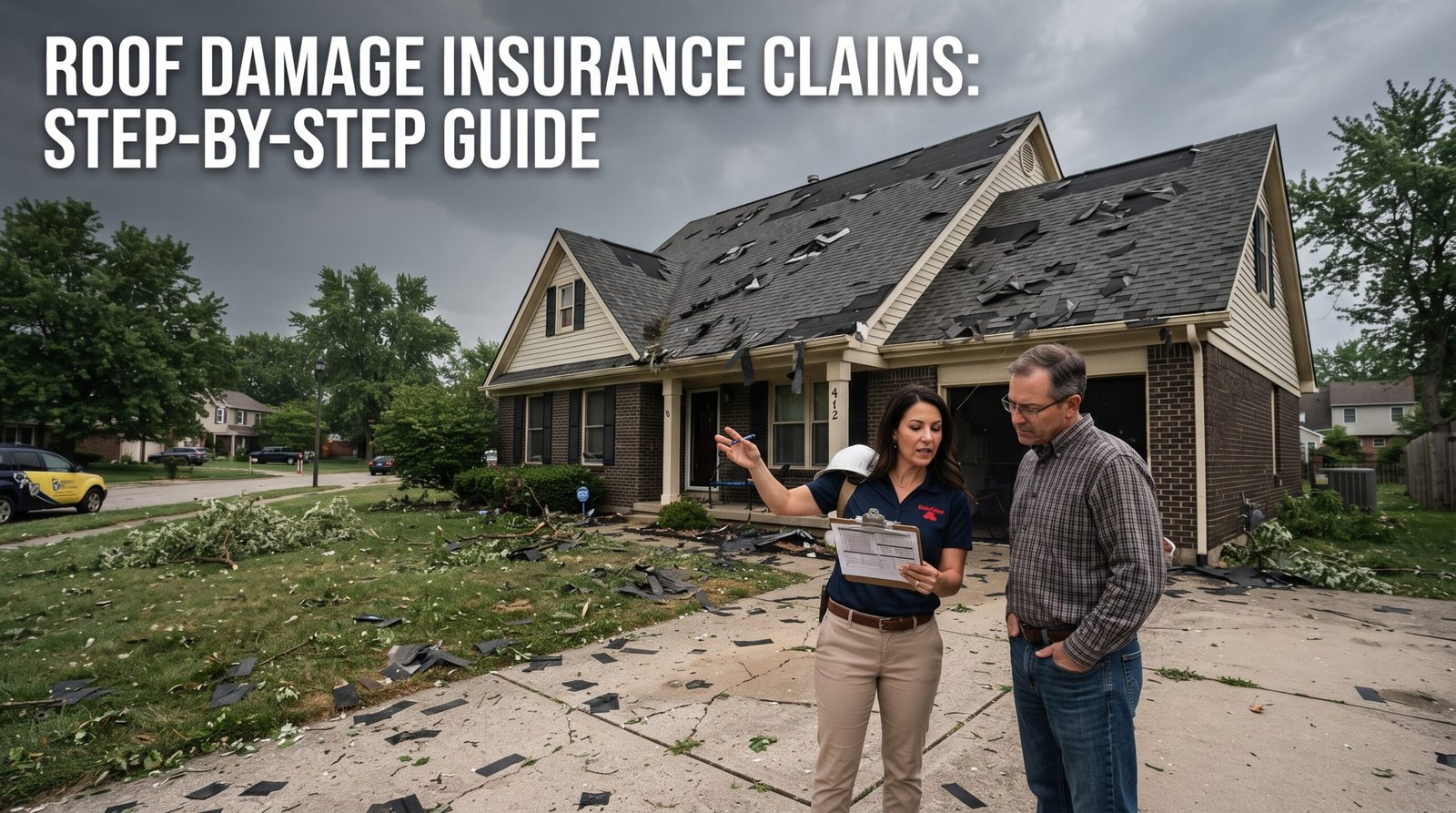
Roof Damage Insurance Claims: Step-by-Step Guide to Getting Paid in 2026- A bad storm rolls through. You walk outside, look up, and your stomach drops. Missing shingles. Dented gutters. Maybe a ceiling stain slowly spreading in your upstairs hallway.
Here’s the good news: roof damage insurance claims, when handled correctly, can cover most — or all — of your repair costs. Here’s the not-so-good news: plenty of homeowners leave serious money on the table because they don’t know the process.
This guide walks you through exactly what to do, step by step, so you don’t make the mistakes that lead to a lowball settlement — or an outright denial.
Understand Your Policy Before You Need It
Before you ever pick up the phone to call your insurer, you need to know what kind of policy you have. There are two main types of roof coverage:
- ACV (Actual Cash Value): Pays you the current depreciated value of your roof — meaning a 15-year-old roof gets paid out at much less than replacement cost.
- RCV (Replacement Cost Value): Pays what it actually costs to replace the roof at today’s prices, minus your deductible.
RCV coverage is significantly better, but it comes with a higher premium. Check your declarations page right now — before you need it.
Also look for an ordinance or law endorsement. Local building codes often require upgrades when a roof is replaced (better ventilation, ice-and-water shield, updated drip edge). Without this endorsement, you pay for those upgrades out of pocket.
Document Everything Immediately After the Storm
This is the most important step. Your documentation is your claim.
From the ground (never climb a damaged or wet roof):
- Walk the entire perimeter and photograph all visible damage
- Check gutters for dents from hail and granules from shingles
- Note any fallen branches or debris that corroborates storm intensity
From inside:
- Check every ceiling and wall for water stains, bubbling paint, or sagging drywall
- Go into your attic with a flashlight — look for daylight showing through, wet insulation, or water streaks along the rafters
- Record a video walkthrough narrating what you see
Store everything in cloud backup immediately. Pull the National Weather Service data for your zip code on the storm date — hail size reports and wind speeds are powerful supporting evidence that insurers take seriously.
Make Temporary Repairs Only
Do not make permanent repairs before your insurance adjuster inspects the damage. This is a fast track to claim denial.
You should take reasonable steps to prevent further damage:
- Have a contractor install emergency tarps over exposed areas (typically $200–$800)
- Use buckets and towels under active leaks
- Run fans and dehumidifiers to slow mold growth
Save every single receipt. Your policy covers reasonable mitigation expenses. Tarp costs, water extraction, even hotel stays if your home becomes uninhabitable — all potentially reimbursable.
File Your Claim Fast
Call your insurer within 48 to 72 hours of discovering damage. Most states give you one to two years to file, but early filing shows you acted promptly — and it closes loopholes for insurers who might argue the damage wasn’t storm-related.
When you call:
- State the date and type of storm clearly
- Describe damage factually (“missing shingles on the south slope, water staining on the upstairs ceiling”)
- Ask about emergency mitigation authorization
- Write down everything — date, time, representative’s name, what was said
That written log becomes invaluable if a dispute arises later.
Prepare for the Adjuster’s Visit
The insurance adjuster works for your insurer — not for you. That doesn’t make them your enemy, but it does mean you should be prepared.
- Have all your documentation organized and ready
- Mark damaged areas with flags or tape so nothing gets missed
- Consider having your own licensed roofing contractor present. They speak the same technical language as the adjuster and can point out damage that might otherwise be overlooked.
- Ask specifically about code upgrade coverage
Real-World Scenario: Say you’re a homeowner in Texas whose roof was hit by a hail storm in July 2026. You have an RCV policy with a $2,500 deductible. Your adjuster scopes the loss at $11,000. Your contractor, who was present during the inspection, points out additional flashing damage and ventilation that must be upgraded per current local code — bringing the total to $14,200. That’s an extra $3,200 you’d have missed without a contractor on site.
Review the Scope of Loss Carefully
After the inspection, your insurer sends a scope-of-loss estimate — usually generated using Xactimate software. It lists every repair line item, material cost, and labor amount.
Do not just accept it. Compare it against your contractor’s independent estimate. Common areas where insurers undervalue claims include:
- Omitting code-required upgrades
- Deprecating labor costs (labor doesn’t depreciate like materials do)
- Missing interior damage tied to the roof breach
- Underestimating square footage or slope complexity
If the numbers don’t match, submit a written rebuttal with your contractor’s estimate attached.
What to Do If Your Claim Is Denied
Denial is not the end of the road. Here’s how to fight back:
- Get the denial in writing — ask for the exact policy language cited
- Hire an independent licensed roofing contractor for a second inspection that specifically addresses the denial reason
- Submit a formal appeal letter via certified mail with all supporting evidence
- Invoke the appraisal clause — most policies allow each side to hire an appraiser; a neutral umpire resolves the dispute
- File a complaint with your state’s Department of Insurance
- Hire a public adjuster — they work on contingency (typically 10–15% of settlement) and are specialists at maximizing payouts
Common Mistake: Many homeowners throw away temporary repair receipts, thinking they’re not covered. Those receipts can reimburse hundreds — sometimes thousands — of dollars in emergency mitigation costs. Keep everything.
The IRS Angle: Casualty Loss Deductions in 2026
Here’s something many homeowners overlook entirely.
Under The Working Families Tax Cuts Act (P.L. 119-21), signed into law and effective beginning in 2026, the casualty loss deduction has been expanded and made permanent by the IRS. Starting this year, personal casualty losses are no longer limited only to federally declared disasters — state-declared disasters now also qualify, provided all requirements under IRC §165 are met.
What does this mean for you? If your roof damage is not fully covered by insurance, the unreimbursed portion may be deductible on your federal return — subject to the $100 per-casualty reduction and 10% AGI floor. You’ll file Form 4684 to claim it.
This is a meaningful update for 2026. In prior years, you had to be in a federally declared disaster zone to claim this deduction. Now, a state-declared disaster opens that door too.
Important: Always consult a licensed tax professional for advice specific to your situation. IRS rules change, and the details matter.
Key Takeaways
- ✅ Know whether your policy is ACV or RCV — it dramatically affects your payout
- ✅ Document damage thoroughly with photos, video, and weather service data before doing anything else
- ✅ File your claim within 48–72 hours of discovering the damage
- ✅ Never make permanent repairs before the adjuster inspects
- ✅ Have a licensed contractor present during the adjuster visit
- ✅ Review the Xactimate scope line by line — don’t accept the first number
- ✅ A denied claim can be appealed; public adjusters and appraisal clauses are powerful tools
- ✅ Starting in 2026, the IRS casualty loss deduction now covers state-declared disasters, not just federal ones
- ✅ Save every receipt — mitigation costs are reimbursable
Conclusion
Filing a roof damage insurance claim doesn’t have to be an overwhelming process. When you document thoroughly, act quickly, stay organized, and know your policy’s details, you put yourself in the strongest possible position for a fair settlement.
The 2026 IRS expansion of the casualty loss deduction adds an extra layer of financial protection for homeowners — especially those in areas hit by state-declared disasters that don’t rise to the federal level. That’s new money on the table that most people don’t even know exists.
Take it step by step. Don’t rush into permanent repairs. And don’t go it alone — a licensed roofing contractor and, if needed, a public adjuster are worth their weight in gold when a large claim is on the line.
FAQ
Q1: Does homeowners insurance always cover roof damage?
Most standard homeowners policies cover sudden, accidental damage from storms, hail, fire, and wind. However, they typically exclude damage caused by age, wear and tear, or lack of maintenance. Check your policy’s specific exclusions carefully.
Q2: What’s the difference between ACV and RCV roof coverage?
ACV (Actual Cash Value) pays the depreciated value of your roof at the time of the loss. RCV (Replacement Cost Value) pays the full cost to replace it with new materials, minus your deductible. RCV coverage results in significantly higher payouts on older roofs.
Q3: How long do I have to file a roof damage insurance claim?
Most states allow one to two years from the date of loss to file a claim. However, filing within 48–72 hours of discovering damage is strongly recommended to protect your position and demonstrate that you acted promptly.
Q4: Can I claim a tax deduction for uninsured roof damage in 2026?
Yes, potentially. Starting in 2026, the IRS expanded the casualty loss deduction under P.L. 119-21 to include losses from state-declared disasters — not just federally declared ones. The unreimbursed portion of your loss may be deductible, subject to a $100 reduction and 10% AGI floor. File Form 4684 and consult a tax professional.
Q5: What should I do if my roof insurance claim is denied?
Request the denial in writing, get an independent contractor inspection, and submit a formal written appeal with supporting documentation. If needed, invoke your policy’s appraisal clause, hire a public adjuster, or file a complaint with your state’s Department of Insurance.
Disclaimer
This article is for informational purposes only and does not constitute legal, tax, or financial advice. Tax rules and insurance regulations vary by state and individual circumstance. Always consult a licensed insurance professional, tax advisor, or attorney for guidance specific to your situation. IRS information referenced is based on official IRS guidance as of August 2026.