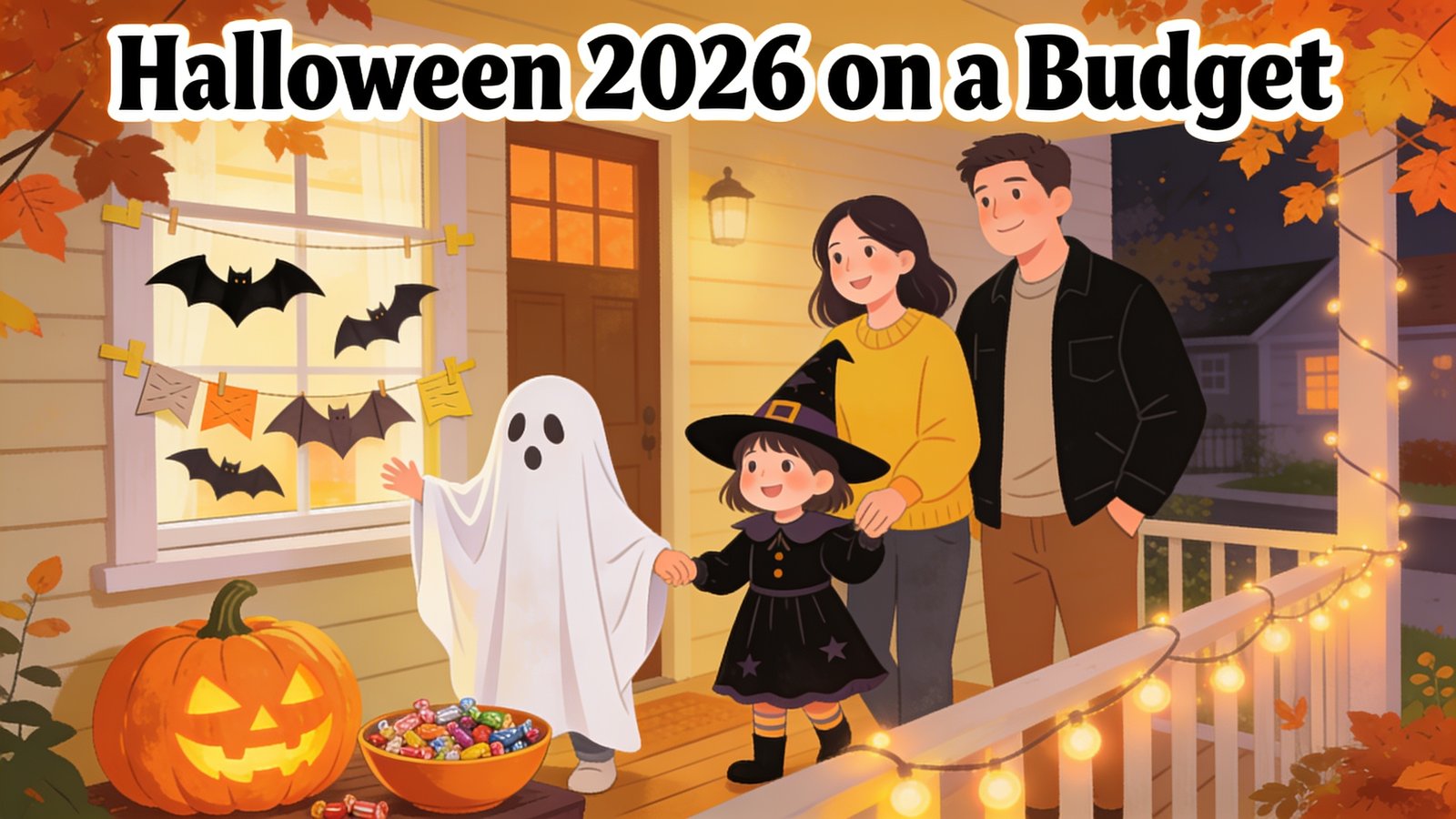
Halloween 2026 on a Budget: How to Celebrate Big Without Spending Big: Halloween is one of the most beloved holidays in America—and also one of the sneakiest budget busters of the year. Before you know it, you’ve dropped $50 on a costume your kid will wear once, $30 on decorations that’ll be in a box by November 1st, and another $40 on candy that may or may not make it to the trick-or-treaters.
Here’s the scary truth: according to the National Retail Federation (NRF), total U.S. Halloween spending in 2025 is expected to hit a record $13.1 billion—up from $11.6 billion in 2024. The average American will spend $114.45 this Halloween, while parents with young kids are on track to spend $305 or more. That’s real money. And a lot of it ends up in the trash by November 2nd.
The good news? You don’t have to spend a dime more than you want to. Celebrating Halloween on a budget is 100% doable—and honestly, some of the most creative, memorable Halloweens happen when you’re working with less. Let’s break it all down.
Why Halloween Costs So Much (And Why It Doesn’t Have To)
Retailers know Halloween is emotional. Parents want their kids to be happy. Adults want to impress at parties. So prices on costumes, décor, and candy get jacked up—sometimes by 500% or more over the actual manufacturing cost, according to personal finance analysts.
A basic child’s costume at a pop-up Halloween store can run $30–$50. The same outfit at a thrift store? $5–$10. The costume is identical. The savings are not.
Understanding the markup helps you make smarter choices. You’re not being cheap—you’re being smart with your money.
Set a Halloween Budget Before You Shop
The single most powerful thing you can do is decide your number before you walk into a store or open Amazon. This sounds obvious, but 1 in 4 Americans have gone into Halloween debt, according to a 2025 LendingTree survey—and 53% of those overspenders say they regret it.
Here’s a simple framework:
- Costumes: Set a firm per-person cap (e.g., $15 per child, $20 per adult)
- Candy: Decide your quantity first, then find the best price per ounce
- Decorations: Allocate a small pool (e.g., $20 total) and stick to it
- Activities/Events: Factor in haunted houses, pumpkin patches, or parties upfront
Write it down. Use a notes app, a spreadsheet, or even a sticky note on your fridge. A written budget is far more powerful than a mental one.
Save Big on Costumes
Costumes are the biggest budget drain—Americans are expected to spend $4.3 billion on costumes in 2025 alone. Here’s how to avoid overpaying:
Shop Thrift Stores First
Goodwill, Salvation Army, and local consignment shops stock costumes year-round—and go crazy with them in September and October. You can find complete outfits for $5–$15. Don’t sleep on this.
Do a Costume Swap
Post in your neighborhood Facebook group or Nextdoor app. Your kid’s superhero costume from last year is someone else’s perfect fit this year. Swaps are free, sustainable, and surprisingly fun.
DIY With What You Own
Some of the most iconic Halloween costumes cost nothing. A black outfit plus paper ears = a cat. A white sheet with holes = a ghost (yes, it still works). A suit jacket plus a name tag = “Hi, I’m Dave from Accounting.” Creativity beats a $75 store costume every time.
Shop Early or Shop Late
Either buy before mid-September when prices are lower, or shop on November 1st when everything is marked down 50–70% for next year. Both strategies work.
Cut Costs on Candy Without Being the “Bad House”
Nobody wants to be the house that gives out raisins. But you also don’t need to spend $40 on a candy mountain.
- Buy in bulk at warehouse clubs like Costco or Sam’s Club—the cost per piece is dramatically lower than retail bags
- Compare price per ounce, not price per bag. A $12 bag of 80 pieces beats a $5 bag of 20 pieces every time
- Shop sales early—many stores run candy promotions through October; stock up when you see a deal
- Mix in low-cost extras like stickers or small erasers to stretch your candy supply without spending more
According to NRF data, Americans will spend $3.9 billion on Halloween candy in 2025. A little math before you buy can save you real dollars.
Affordable Halloween Decorations That Still Look Great
Decorations account for $4.2 billion in projected 2025 Halloween spending. Here’s the truth: most of it is for stuff that sits in a box 11 months a year.
Free and Near-Free Ideas
- Fallen leaves in a pile by the door = instant autumn vibe
- Carved pumpkins from a local farm stand cost far less than pre-decorated versions
- Paper cutouts of bats, ghosts, and spiders—print them free online, cut them out, and tape them up
- Candles in paper bags = cheap luminaries that look fantastic at night
- String lights you already own from Christmas? They work in orange too
Buy Once, Reuse Every Year
If you do buy decorations, invest in quality pieces that’ll last—not flimsy plastic that breaks by mid-October. One solid $15 decoration beats five $5 ones that fall apart.
Budget-Friendly Halloween Activities for Families
Haunted houses can run $25–$50 per person. A fall festival outing for a family of four can easily hit $100 before you’ve bought a single pumpkin. There are better ways.
- Trunk-or-treat events at local churches, schools, or community centers are often free or low-cost
- Neighborhood trick-or-treating is still the gold standard—and it’s free
- DIY haunted hallway at home: turn off the lights, use sound effects from YouTube, and let the kids run through. Cost: $0
- Halloween movie night with microwave popcorn and your existing streaming subscription beats a $15/person haunted attraction
- Pumpkin decorating contest at home—buy one pumpkin per person and let creativity do the rest
Real-World Example: A $60 Halloween for a Family of Four
Say you’re a parent of two kids, ages 6 and 9, with a $60 total Halloween budget. Here’s how that actually plays out:
| Category | Budget Approach | Cost |
|---|---|---|
| Kid #1 Costume | Thrift store find | $8 |
| Kid #2 Costume | DIY from closet | $0 |
| Adult Costumes | Costume swap with neighbor | $0 |
| Candy | Bulk bag at Costco | $18 |
| Decorations | Paper cutouts and pumpkins from the farm stand | $14 |
| Activities | Neighborhood trick-or-treat + home movie night | $0 |
| Snacks for movie night | Store-brand popcorn and hot cider | $10 |
| Total | $50 |
You came in $10 under budget—and the kids had a blast. That’s what planning does.
Common Mistake: The Last-Minute Splurge
Here’s the most common financial mistake people make at Halloween: waiting until the last week of October to shop.
By then, the costume your kid wants is only available in-store at a pop-up shop with full retail markups. Bulk candy deals are gone. Amazon Prime shipping costs extra. And you’re stressed, so you just grab whatever is on the shelf—at full price.
According to PwC’s 2025 Halloween survey, 34% of consumers had already spent half their Halloween budget before late September, and 28% shopped early specifically because of price concerns. The early shoppers consistently spend less and feel less financial stress.
Start your Halloween budget in late August or early September. A little early planning saves a surprising amount of money.
Key Takeaways
- 🎃 U.S. Halloween spending hit a record $13.1 billion in 2025—but you don’t have to contribute more than your share
- 📋 Set a written budget with category limits before you shop—it’s the single most effective move
- 👗 Thrift stores, costume swaps, and DIY can cut costume costs by 70–90%
- 🍬 Buy candy in bulk and compare price-per-piece, not price-per-bag
- 🕷️ Free decorations—paper cutouts, candles, leaves—look just as good as store-bought
- 📅 Shop early (August–September) or shop late (November 1st clearance) to avoid peak-price traps
- 🚫 Avoid last-minute shopping—it’s the #1 cause of Halloween overspending and post-holiday regret
Conclusion
Halloween is supposed to be fun—not a source of financial anxiety. The holiday itself costs nothing. The commercialization of it costs plenty. But when you celebrate Halloween on a budget with a little planning, a little creativity, and a firm number in mind, you get all the fun without the November credit card guilt.
A thrift store costume, a bag of bulk candy, some homemade paper bats on the window, and a scary movie with your family — that’s a genuinely great Halloween. And it can cost less than $60 for an entire household.
So before October sneaks up on you, sit down, set your number, and make a plan. Your wallet will thank you on November 1st.
Frequently Asked Questions
Q1: What is a reasonable Halloween budget for a family?
A reasonable Halloween budget for a family of four is $50–$100, depending on your location and how much you celebrate. By shopping at thrift stores, buying candy in bulk, and using DIY decorations, most families can have a full Halloween experience well under $100.
Q2: How can I save money on Halloween costumes?
The best ways are to shop at thrift stores ($5–$15 per costume), do a costume swap with friends or neighbors, or DIY a costume using clothes you already own. Avoid pop-up Halloween stores, which charge the highest markups of the season.
Q3: When is the best time to buy Halloween candy on a budget?
Buy candy in bulk at warehouse clubs like Costco or Sam’s Club in September or early October, before prices spike. Alternatively, buy on November 1st for 50–70% off—stock it for next year.
Q4: Is it worth buying Halloween decorations?
Only if you plan to reuse them for years. One-use plastic decorations are rarely worth the cost. Free alternatives—paper cutouts, carved pumpkins, candles—look great and cost almost nothing.
Disclaimer: This article is for informational and educational purposes only and does not constitute financial advice. Spending figures and statistics are sourced from the National Retail Federation (NRF), LendingTree, and PwC’s 2025 Halloween consumer surveys. Individual financial situations vary. Consult a qualified financial advisor for personalized guidance.