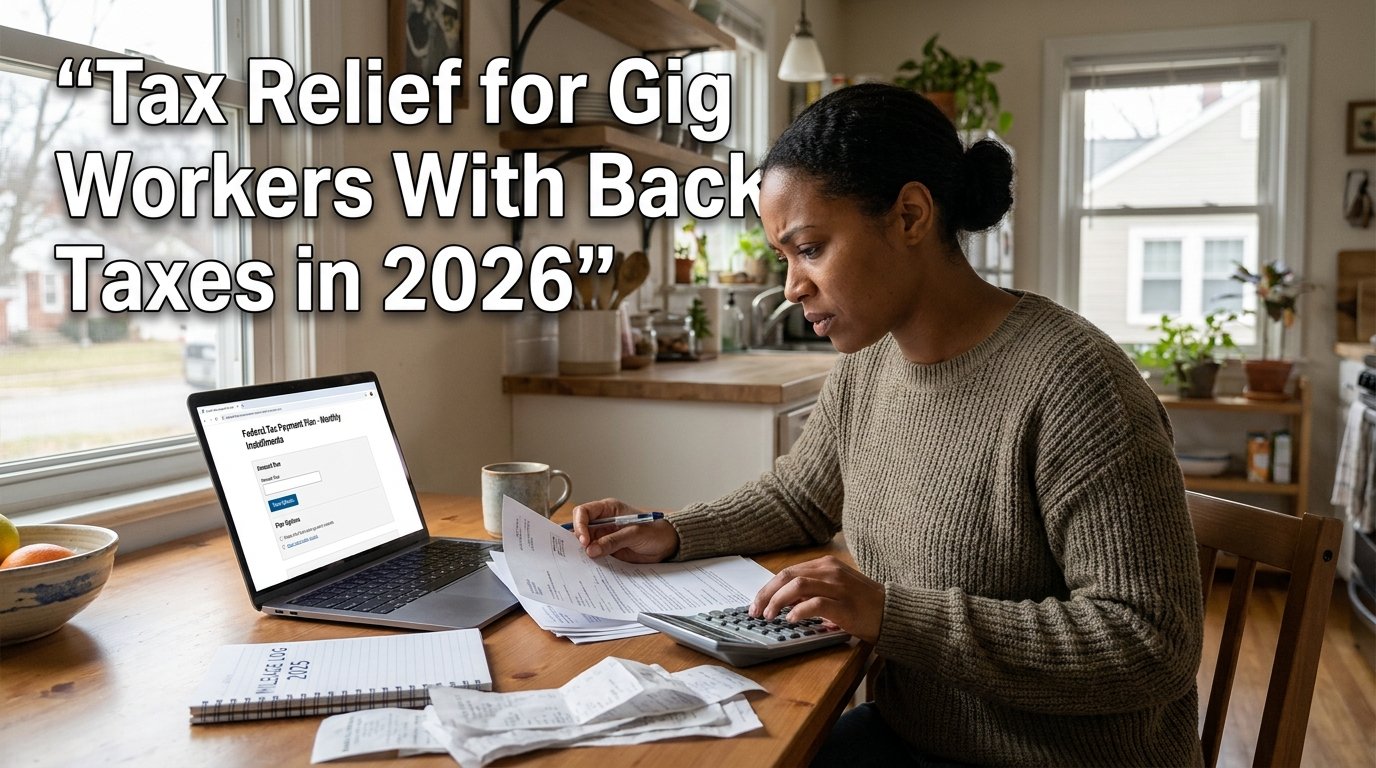
Tax Relief for Gig Workers With Back Taxes in 2026: IRS Options That May Help- If you drive for a rideshare app, deliver food, freelance online, rent out equipment, or run another side business, unpaid taxes can grow quickly. The good news is that tax relief for gig workers 2026 is not limited to traditional employees. Independent contractors may qualify for IRS payment plans, penalty relief, hardship status, or an Offer in Compromise.
You still need to file every required tax return, even if you cannot pay the balance. This guide explains the main IRS options, newer 2026 tax provisions, and practical steps to stop a growing tax problem from becoming a collection crisis.
Why Gig Workers Often Owe Back Taxes
Employees usually have federal income tax withheld from each paycheck. Gig workers generally receive payments without withholding, so they must calculate and pay their own income and self-employment taxes.
You may owe:
Self-employment tax for Social Security and Medicare.
State and local income taxes.
Estimated tax penalties if payments were late or too low.
Interest and failure-to-file or failure-to-pay penalties.
Gig income is commonly reported on Schedule C, Profit or Loss From Business, attached to Form 1040. The IRS says self-employed taxpayers may need estimated payments and can use Form 1040-ES to calculate them.irs+1
A 1099 form does not mean the reported amount is your taxable profit. You generally calculate profit after eligible business expenses. However, you must keep records that support those expenses.
The common mistake
One of the most costly mistakes is treating every dollar received from an app or client as spendable income. A driver may receive $60,000 from platforms but have deductible business costs that reduce taxable profit. On the other hand, claiming unsupported expenses can create a second problem if the IRS examines the return.
Tax Relief for Gig Workers 2026
Several forms of tax relief for gig workers 2026 may reduce what you owe or make repayment manageable. These options do not automatically erase a tax bill, and eligibility depends on your income, assets, filing history, and financial circumstances.
1. IRS installment agreement
An installment agreement lets you pay your tax debt over time. You normally continue making monthly payments while interest and some penalties continue to accrue.
The IRS offers different payment-plan types. A short-term plan may be available for individuals who owe less than $100,000 in combined tax, penalties, and interest and can pay within 180 days.
If you need more time, you may request a long-term installment agreement online or with Form 9465. The IRS may ask for financial information, especially when your balance or payment request falls outside streamlined terms.
A payment plan can help you avoid ignoring collection notices. However, you must remain current with future returns and payments. Missing new tax obligations can cause the agreement to default.
2. Penalty abatement
Penalties can add substantially to a gig worker’s balance. You may request relief under the IRS’s administrative programs or based on reasonable cause.
Reasonable cause may apply when circumstances beyond your control prevented timely filing or payment. Examples can include a serious illness, natural disaster, death in the immediate family, or another documented event. The IRS generally expects you to show that you exercised ordinary business care and prudence.irs+1
In July 2026, the IRS announced a phase-in of an Automatic Exemption from Penalty program for certain penalties connected with 2025 returns and 2026 quarterly returns. Eligibility depends on the taxpayer’s filing and payment history, so you should review your IRS account or notice rather than assume the relief applies.irs+1
Penalty relief normally does not remove the underlying tax or interest. Ask the IRS to identify which penalties are eligible before estimating your total savings.
3. Offer in Compromise
An Offer in Compromise allows an eligible taxpayer to settle federal tax debt for less than the full amount owed. The IRS evaluates whether the proposed amount reflects the taxpayer’s reasonable collection potential.
This option is not a quick discount program. The IRS typically reviews:
Income from gig work and other sources.
Bank accounts and investments.
Vehicles, real estate, and other assets.
Necessary living expenses.
Ability to earn income in the future.
Filing and payment compliance.
You generally must file all required returns before the IRS will seriously consider an offer. You also need to remain compliant while the offer is pending and after acceptance.
4. Currently Not Collectible status
If paying anything would prevent you from meeting basic living expenses, you may request Currently Not Collectible status. The IRS can temporarily suspend most collection activity after reviewing your financial condition.
CNC status does not cancel the debt. Interest and penalties may continue, and the IRS can review your finances later. You may need to complete a Collection Information Statement, such as Form 433-A, and provide proof of income, expenses, assets, and debts.
This option may fit a gig worker whose income dropped sharply, whose vehicle broke down, or who cannot cover housing, food, utilities, transportation, and necessary medical costs after making a payment.
Newer Tax Breaks to Review
Relief from back taxes begins with accurate returns. Before agreeing to a payment plan, check whether earlier returns properly included available deductions and credits.
Qualified business expenses
Common expenses may include:
Business-use vehicle costs.
Phone and internet expenses related to the business.
Platform fees and commissions.
Supplies, equipment, and software.
Advertising and professional fees.
A qualifying home-office deduction.
You cannot deduct personal expenses merely because they help you work. For mixed-use expenses, deduct only the business portion and keep a reasonable allocation method.
Vehicle deductions
For 2026, the IRS initially listed a business mileage rate of 72.5 cents per mile. The IRS later announced a revised rate of 76 cents per business mile for miles driven from July 1 through December 31, 2026.irs+1
Keep a mileage log showing the date, destination, business purpose, and miles. Do not count ordinary personal driving, and do not claim both the standard mileage method and actual vehicle expenses for the same miles.
Tip deduction
The IRS says eligible employees and self-employed workers in qualifying tipped occupations may claim a deduction for qualified tips under provisions enacted in 2025. The deduction can be as high as $25,000, subject to income limits and other rules.
Not every payment labeled a “tip” qualifies. You need to report the income and meet the applicable occupation and payment requirements. Because this is a newer provision, review the latest IRS instructions for the tax year involved.
Qualified business income deduction
Eligible sole proprietors and other pass-through business owners may qualify for the qualified business income deduction. The calculation can be limited by taxable income, business type, and other factors.
A deduction may reduce taxable income, but it does not eliminate self-employment tax. That distinction matters when estimating what a gig business actually owes.
How to Address Several Years of Back Taxes
If you have multiple unfiled returns, do not wait until you can pay everything. Filing and payment are separate issues.
Step 1: Collect your records
Gather:
1099-NEC, 1099-K, and other income forms.
Bank statements and platform payment histories.
Mileage and vehicle records.
Receipts for business expenses.
Prior tax returns.
IRS notices and account transcripts.
Proof of major hardship expenses.
If a platform did not issue a form, you may still have to report the income.
Step 2: Get account information
An IRS transcript can help you identify filed returns, reported income, balances, and penalties. Compare IRS information with your own records before preparing an amended or late return.
Step 3: File the missing returns
File accurate returns for each year that requires one. If you cannot pay, consider requesting a payment arrangement after filing. Filing late can reduce the failure-to-file penalty compared with continuing to wait.
Do not invent expenses to lower the balance. A smaller return is not helpful if it cannot be supported.
Step 4: Calculate a realistic payment
Create a monthly budget using average gig income rather than your best month. Include fuel, maintenance, insurance, taxes, food, rent or mortgage, utilities, health costs, and debt payments.
The IRS may compare your financial statement with documentation. A payment that looks affordable on paper but leaves you unable to pay essential expenses may not be sustainable.
Step 5: Choose the right relief path
A payment plan may be appropriate when you can repay the debt over time. Penalty abatement may help when a specific event caused the late filing or payment. CNC status may fit severe hardship, while an Offer in Compromise is generally reserved for taxpayers who meet its collection and eligibility tests.
A tax professional can be useful when several years, business assets, audit issues, or collection enforcement are involved. Look for an enrolled agent, certified public accountant, or tax attorney with IRS collection experience.
Example: A Driver With Back Taxes
Say you are a single filer who earned $52,000 from rideshare and delivery work during a year. After eligible business expenses, your Schedule C profit is lower than the gross amount shown in your platform records, but you still owe income and self-employment tax because no employer withheld it.
You have filed the return but cannot pay the full balance. First, you review your account and request penalty relief if you have a qualifying reason. Then you apply for an installment agreement based on a documented monthly budget.
If your income has since fallen and even a small payment would prevent you from paying rent, food, utilities, and necessary transportation, you could ask the IRS to evaluate you for CNC status instead. The debt would remain, but collection activity might be paused temporarily.
Preventing a New Tax Balance
The best tax relief for gig workers 2026 is avoiding another unpaid bill while resolving the old one.
Use these habits:
Move a portion of every payment into a separate tax savings account.
Track income and expenses weekly instead of reconstructing them at tax time.
Make estimated payments with Form 1040-ES when required.
Recalculate payments when your gig income changes.
Keep mileage and receipt records for the required retention period.
Review every IRS notice promptly.
File a return even when you cannot pay the balance in full.
The IRS lists four estimated-tax payment periods, with general due dates in April, June, September, and January. Your exact due date can change when a weekend, holiday, or disaster-related extension applies.
Key Takeaways
Gig workers can use IRS payment plans, penalty relief, CNC status, or an Offer in Compromise if they meet the requirements.
File all required returns before focusing on how to pay the balance.
A payment plan does not usually stop interest from accruing.
Penalty relief requires a qualifying history, reasonable cause, or another IRS-approved basis.
CNC status delays collection but does not erase the debt.
Keep records for mileage, platform fees, supplies, equipment, and other business expenses.
The 2026 business mileage rules include a midyear rate change, so use the correct rate for each period.
Continue paying current-year estimated taxes while resolving older balances.
Conclusion
Tax relief for gig workers 2026 starts with accurate returns, complete records, and quick action on IRS notices. If you have back taxes, you may be able to reduce penalties, pay through an installment agreement, temporarily pause collection, or settle for less if you qualify for an Offer in Compromise.
Do not assume that an unpayable bill must be ignored. Review your IRS account, file missing returns, and choose a relief option that matches your real financial situation.
FAQ
What is tax relief for gig workers 2026?
Tax relief for gig workers 2026 includes IRS programs and tax provisions that may reduce penalties, lower taxable income, or make back taxes easier to repay. Common options include installment agreements, reasonable-cause relief, CNC status, and Offers in Compromise.
Can a gig worker get an IRS payment plan for back taxes?
Yes. Gig workers may request an IRS payment plan if they meet the applicable requirements. Short-term and long-term options are available, but you generally must file required returns and stay current with future tax obligations.
Does the IRS forgive back taxes for freelancers?
The IRS does not routinely forgive gig-worker tax debt. An Offer in Compromise can settle eligible debt for less than the full amount, but the IRS reviews your financial information and reasonable collection potential.
Can IRS penalties on 1099 income be removed?
Possibly. You may qualify for administrative relief, automatic relief under an applicable IRS program, or reasonable-cause relief. You must meet the requirements and may need to provide an explanation and supporting documents.irs+1
What should I do if I cannot pay my gig-worker taxes?
File the required returns, pay what you can, review your IRS balance, and request a payment plan or hardship evaluation. If you cannot pay basic living expenses, ask whether Currently Not Collectible status may apply.
Disclaimer
This article provides general educational information based on IRS guidance and tax developments available as of August 2026. Tax rules, forms, deadlines, and eligibility requirements can change. It is not tax, legal, or financial advice, and it does not create a professional-client relationship. Consult the IRS, a qualified tax professional, or an authorized representative about your specific circumstances.